


Page 175 - Read Online
P. 175
Page 18 of 28                                                        Wang et al. Soft Sci. 2026, 6, 8


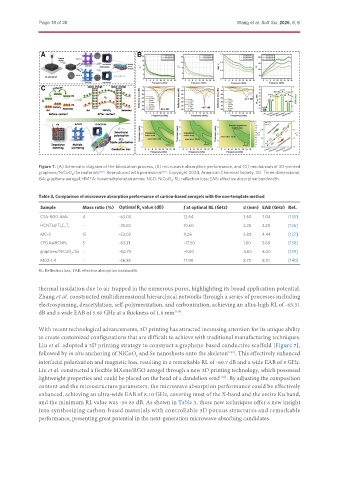
               Figure 7. (A) Schematic diagram of the fabrication process, (B) microwave absorption performance, and (C) mechanism of 3D-printed
               graphene/NiCoO 2 /Se materials [139] . Reproduced with permission [139] . Copyright 2024, American Chemical Society. 3D: Three-dimensional;
               GA: graphene aerogel; HMTA: hexamethylenetetramine; NCO: NiCoO 2 ; RL: reflection loss; EAB: effective absorption bandwidth.

               Table 3. Comparison of microwave absorption performance of carbon-based aerogels with the non-template method

               Sample         Mass ratio (%)  Optimal R L  value (dB)  f at optimal RL (GHz)  d (mm) EAB (GHz) Ref.
               CSA-RGO AMs    4            -63.00                 12.64               3.60   7.04     [135]
                              -            -35.50                 10.60               2.20   2.20     [136]
               HCNTs@Ti 3 C 2 T x
               MC-3           15           -53.02                 9.28                3.80   4.44     [137]
               CPDA@RCNFs     5            -63.31                 ~17.50              1.80   5.60     [138]
               graphene/NiCoO 2 /Se -      -60.70                 ~9.00               4.60   8.00     [139]
               MG2-1.4        -            -56.85                 17.90               2.70   8.10     [140]

               RL: Reflection loss; EAB: effective absorption bandwidth.

               thermal insulation due to air trapped in the numerous pores, highlighting its broad application potential.
               Zhang et al. constructed multidimensional hierarchical networks through a series of processes including
               electrospinning, deacetylation, self-polymerization, and carbonization, achieving an ultra-high RL of -63.31
               dB and a wide EAB of 5.60 GHz at a thickness of 1.8 mm .
                                                              [138]
               With recent technological advancements, 3D printing has attracted increasing attention for its unique ability
               to create customized configurations that are difficult to achieve with traditional manufacturing techniques.
               Liu et al. adopted a 3D printing strategy to construct a graphene-based conductive scaffold [Figure 7],
               followed by in situ anchoring of NiCoO  and Se nanosheets onto the skeleton [139] . This effectively enhanced
                                                 2
               interfacial polarization and magnetic loss, resulting in a remarkable RL of -60.7 dB and a wide EAB of 8 GHz.
               Liu et al. constructed a flexible MXene/RGO aerogel through a new 3D printing technology, which possessed
               lightweight properties and could be placed on the head of a dandelion seed . By adjusting the composition
                                                                              [140]
               content and the microstructure parameters, the microwave absorption performance could be effectively
               enhanced, achieving an ultra-wide EAB of 8.10 GHz, covering most of the X-band and the entire Ku band,
               and the minimum RL value was -56.85 dB. As shown in Table 3, these new techniques offer a new insight
               into synthesizing carbon-based materials with controllable 3D porous structures and remarkable
               performance, presenting great potential in the next-generation microwave-absorbing candidates.

