


Page 98 - Read Online
P. 98
Tang et al. Soft Sci. 2025, 5, 11  https://dx.doi.org/10.20517/ss.2024.62        Page 9 of 21

               is crucial for the implementation of touchless thermal sensation.


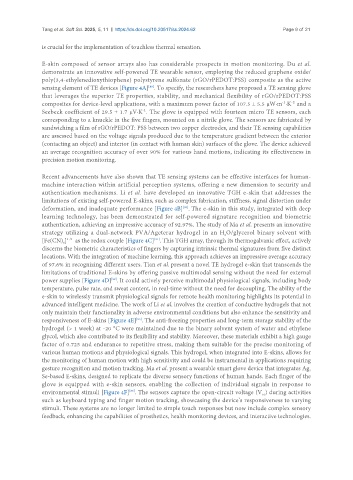
               E-skin composed of sensor arrays also has considerable prospects in motion monitoring. Du et al.
               demonstrate an innovative self-powered TE wearable sensor, employing the reduced graphene oxide/
               poly(3,4-ethylenedioxythiophene) polystyrene sulfonate (rGO/rPEDOT:PSS) composite as the active
               sensing element of TE devices [Figure 4A] . To specify, the researchers have proposed a TE sensing glove
                                                   [89]
               that leverages the superior TE properties, stability, and mechanical flexibility of rGO/rPEDOT:PSS
               composites for device-level applications, with a maximum power factor of 107.5 ± 5.5 µW·m ¹·K ² and a
                                                                                                   -
                                                                                                -
               Seebeck coefficient of 29.5 ± 1.7 µV·K ¹. The glove is equipped with fourteen micro TE sensors, each
                                                 -
               corresponding to a knuckle in the five fingers, mounted on a nitrile glove. The sensors are fabricated by
               sandwiching a film of rGO/rPEDOT: PSS between two copper electrodes, and their TE sensing capabilities
               are assessed based on the voltage signals produced due to the temperature gradient between the exterior
               (contacting an object) and interior (in contact with human skin) surfaces of the glove. The device achieved
               an average recognition accuracy of over 90% for various hand motions, indicating its effectiveness in
               precision motion monitoring.

               Recent advancements have also shown that TE sensing systems can be effective interfaces for human-
               machine interaction within artificial perception systems, offering a new dimension to security and
               authentication mechanisms. Li et al. have developed an innovative TGH e-skin that addresses the
               limitations of existing self-powered E-skins, such as complex fabrication, stiffness, signal distortion under
                                                               [90]
               deformation, and inadequate performance [Figure 4B] . The e-skin in this study, integrated with deep
               learning technology, has been demonstrated for self-powered signature recognition and biometric
               authentication, achieving an impressive accuracy of 92.97%. The study of Ma et al. presents an innovative
               strategy utilizing a dual-network PVA/Ageterar hydrogel in an H O/glycerol binary solvent with
                                                                             2
               [Fe(CN) ]  as the redox couple [Figure 4C] . This TGH array, through its thermogalvanic effect, actively
                                                     [91]
                        3-/4-
                      6
               discerns the biometric characteristics of fingers by capturing intrinsic thermal signatures from five distinct
               locations. With the integration of machine learning, this approach achieves an impressive average accuracy
               of 97.6% in recognizing different users. Tian et al. present a novel TE hydrogel e-skin that transcends the
               limitations of traditional E-skins by offering passive multimodal sensing without the need for external
               power supplies [Figure 4D] . It could actively perceive multimodal physiological signals, including body
                                       [92]
               temperature, pulse rate, and sweat content, in real-time without the need for decoupling. The ability of the
               e-skin to wirelessly transmit physiological signals for remote health monitoring highlights its potential in
               advanced intelligent medicine. The work of Li et al. involves the creation of conductive hydrogels that not
               only maintain their functionality in adverse environmental conditions but also enhance the sensitivity and
                                               [93]
               responsiveness of E-skins [Figure 4E] . The anti-freezing properties and long-term storage stability of the
               hydrogel (> 1 week) at -20 °C were maintained due to the binary solvent system of water and ethylene
               glycol, which also contributed to its flexibility and stability. Moreover, these materials exhibit a high gauge
               factor of 0.725 and endurance to repetitive stress, making them suitable for the precise monitoring of
               various human motions and physiological signals. This hydrogel, when integrated into E-skins, allows for
               the monitoring of human motion with high sensitivity and could be instrumental in applications requiring
               gesture recognition and motion tracking. Ma et al. present a wearable smart glove device that integrates Ag 2
               Se-based E-skins, designed to replicate the diverse sensory functions of human hands. Each finger of the
               glove is equipped with e-skin sensors, enabling the collection of individual signals in response to
               environmental stimuli [Figure 4F] . The sensors capture the open-circuit voltage (V ) during activities
                                             [85]
                                                                                         oc
               such as keyboard typing and finger motion tracking, showcasing the device’s responsiveness to varying
               stimuli. These systems are no longer limited to simple touch responses but now include complex sensory
               feedback, enhancing the capabilities of prosthetics, health monitoring devices, and interactive technologies.

