


Page 95 - Read Online
P. 95
Page 6 of 21                           Tang et al. Soft Sci. 2025, 5, 11  https://dx.doi.org/10.20517/ss.2024.62

               an electromotive force (EMF). This potential difference is what drives the flow of electrons through an
               external circuit, enabling electrical energy generation for sensing.

               The conversion efficiency of thermocells is determined by three interconnected factors: the thermopower
               (Se), the effective electrical conductivity (σ ), and the effective thermal conductivity (κ ). The thermal
                                                                                            eff
                                                     eff
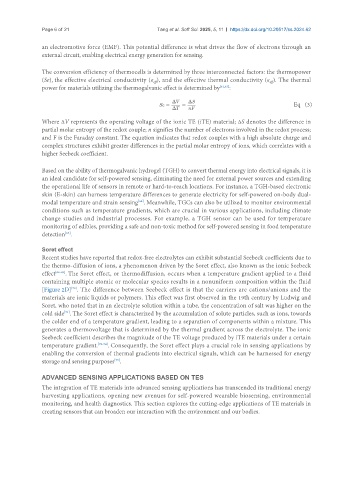
               power for materials utilizing the thermogalvanic effect is determined by [61,63] :
                                                                                                    Eq   (3)


               Where ΔV represents the operating voltage of the ionic TE (iTE) material; ΔS denotes the difference in
               partial molar entropy of the redox couple; n signifies the number of electrons involved in the redox process;
               and F is the Faraday constant. The equation indicates that redox couples with a high absolute charge and
               complex structures exhibit greater differences in the partial molar entropy of ions, which correlates with a
               higher Seebeck coefficient.

               Based on the ability of thermogalvanic hydrogel (TGH) to convert thermal energy into electrical signals, it is
               an ideal candidate for self-powered sensing, eliminating the need for external power sources and extending
               the operational life of sensors in remote or hard-to-reach locations. For instance, a TGH-based electronic
               skin (E-skin) can harness temperature differences to generate electricity for self-powered on-body dual-
               modal temperature and strain sensing . Meanwhile, TGCs can also be utilized to monitor environmental
                                                [64]
               conditions such as temperature gradients, which are crucial in various applications, including climate
               change studies and industrial processes. For example, a TGH sensor can be used for temperature
               monitoring of edibles, providing a safe and non-toxic method for self-powered sensing in food temperature
                       [65]
               detection .

               Soret effect
               Recent studies have reported that redox-free electrolytes can exhibit substantial Seebeck coefficients due to
               the thermo-diffusion of ions, a phenomenon driven by the Soret effect, also known as the ionic Seebeck
               effect [66-69] . The Soret effect, or thermodiffusion, occurs when a temperature gradient applied to a fluid
               containing multiple atomic or molecular species results in a nonuniform composition within the fluid
                         [70]
               [Figure 2D] . The difference between Seebeck effect is that the carriers are cations/anions and the
               materials are ionic liquids or polymers. This effect was first observed in the 19th century by Ludwig and
               Soret, who noted that in an electrolyte solution within a tube, the concentration of salt was higher on the
               cold side . The Soret effect is characterized by the accumulation of solute particles, such as ions, towards
                       [71]
               the colder end of a temperature gradient, leading to a separation of components within a mixture. This
               generates a thermovoltage that is determined by the thermal gradient across the electrolyte. The ionic
               Seebeck coefficient describes the magnitude of the TE voltage produced by iTE materials under a certain
               temperature gradient. [72-74] . Consequently, the Soret effect plays a crucial role in sensing applications by
               enabling the conversion of thermal gradients into electrical signals, which can be harnessed for energy
               storage and sensing purposes .
                                        [75]

               ADVANCED SENSING APPLICATIONS BASED ON TES
               The integration of TE materials into advanced sensing applications has transcended its traditional energy
               harvesting applications, opening new avenues for self-powered wearable biosensing, environmental
               monitoring, and health diagnostics. This section explores the cutting-edge applications of TE materials in
               creating sensors that can broaden our interaction with the environment and our bodies.

