


Page 96 - Read Online
P. 96
Tang et al. Soft Sci. 2025, 5, 11  https://dx.doi.org/10.20517/ss.2024.62        Page 7 of 21

               E-skin and tactile sensory
               E-skin is a flexible and stretchable electronic device that mimics the functions of human skin, capable of
               converting external mechanical or thermal stimuli into electrical signals. These signals can then be
               processed and interpreted by connected devices or systems, allowing for numerous applications in fields
               including robotics and wearable technology [64,76-81] . For E-skin, which requires durable power sources, TE
               generators (TEGs) could provide a means of self-sustaining energy. By incorporating TEGs, E-skin could
               benefit from a continuous and autonomous power supply, enhancing its functionality and extending its
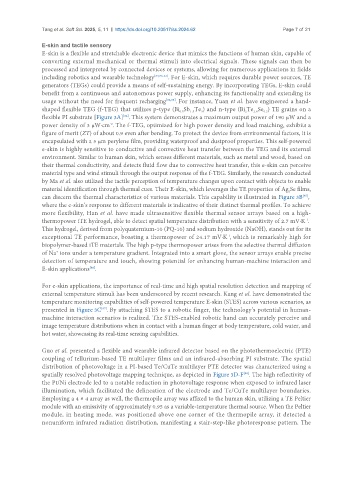
               usage without the need for frequent recharging [82,83] . For instance, Yuan et al. have engineered a hand-
               shaped flexible TEG (f-TEG) that utilizes p-type (Bi Sb Te ) and n-type (Bi Te Se ) TE grains on a
                                                                                          0.2
                                                                     3
                                                                                    2
                                                                                      2.8
                                                              0.5
                                                                 1.5
               flexible PI substrate [Figure 3A] . This system demonstrates a maximum output power of 190 µW and a
                                           [84]
               power density of 3 µW·cm . The f-TEG, optimized for high power density and load matching, exhibits a
                                      -2
               figure of merit (ZT) of about 0.9 even after bending. To protect the device from environmental factors, it is
               encapsulated with a 5 μm perylene film, providing waterproof and dustproof properties. This self-powered
               e-skin is highly sensitive to conductive and convective heat transfer between the TEG and its external
               environment. Similar to human skin, which senses different materials, such as metal and wood, based on
               their thermal conductivity, and detects fluid flow due to convective heat transfer, this e-skin can perceive
               material type and wind stimuli through the output response of the f-TEG. Similarly, the research conducted
               by Ma et al. also utilized the tactile perception of temperature changes upon contact with objects to enable
               material identification through thermal cues. Their E-skin, which leverages the TE properties of Ag Se films,
                                                                                                  2
               can discern the thermal characteristics of various materials. This capability is illustrated in Figure 3B ,
                                                                                                       [85]
               where the e-skin’s response to different materials is indicative of their distinct thermal profiles. To achieve
               more flexibility, Han et al. have made ultrasensitive flexible thermal sensor arrays based on a high-
               thermopower iTE hydrogel, able to detect spatial temperature distribution with a sensitivity of 2.7 mV·K .
                                                                                                        -1
               This hydrogel, derived from polyquaternium-10 (PQ-10) and sodium hydroxide (NaOH), stands out for its
               exceptional TE performance, boasting a thermopower of 24.17 mV·K , which is remarkably high for
                                                                              -1
               biopolymer-based iTE materials. The high p-type thermopower arises from the selective thermal diffusion
               of Na  ions under a temperature gradient. Integrated into a smart glove, the sensor arrays enable precise
                    +
               detection of temperature and touch, showing potential for enhancing human-machine interaction and
                               [86]
               E-skin applications .
               For e-skin applications, the importance of real-time and high spatial resolution detection and mapping of
               external temperature stimuli has been underscored by recent research. Kang et al. have demonstrated the
               temperature monitoring capabilities of self-powered temperature E-skin (STES) across various scenarios, as
                                   [87]
               presented in Figure 3C . By attaching STES to a robotic finger, the technology’s potential in human-
               machine interaction scenarios is realized. The STES-enabled robotic hand can accurately perceive and
               image temperature distributions when in contact with a human finger at body temperature, cold water, and
               hot water, showcasing its real-time sensing capabilities.


               Guo et al. presented a flexible and wearable infrared detector based on the photothermoelectric (PTE)
               coupling of tellurium-based TE multilayer films and an infrared-absorbing PI substrate. The spatial
               distribution of photovoltage in a PI-based Te/CuTe multilayer PTE detector was characterized using a
                                                                                   [88]
               spatially resolved photovoltage mapping technique, as depicted in Figure 3D-F . The high reflectivity of
               the Pt/Ni electrode led to a notable reduction in photovoltage response when exposed to infrared laser
               illumination, which facilitated the delineation of the electrode and Te/CuTe multilayer boundaries.
               Employing a 4 × 4 array as well, the thermopile array was affixed to the human skin, utilizing a TE Peltier
               module with an emissivity of approximately 0.95 as a variable-temperature thermal source. When the Peltier
               module, in heating mode, was positioned above one corner of the thermopile array, it detected a
               nonuniform infrared radiation distribution, manifesting a stair-step-like photoresponse pattern. The

