


Page 97 - Read Online
P. 97
Page 8 of 21                           Tang et al. Soft Sci. 2025, 5, 11  https://dx.doi.org/10.20517/ss.2024.62


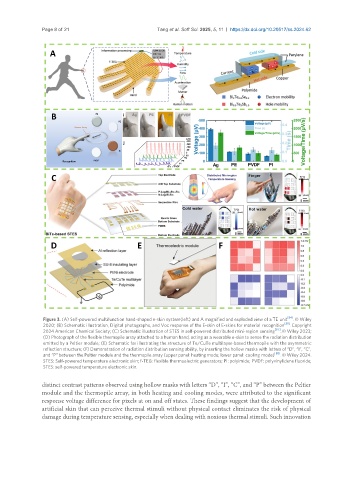
                Figure 3. (A) Self-powered multifunction hand-shaped e-skin system(left) and A magnified and exploded view of a TE unit [84] . © Wiley
                2020; (B) Schematic illustration, Digital photographs, and Voc response of the E-skin of E-skins for material  recognition [85] . Copyright
                2024 American Chemical Society; (C) Schematic illustration of STES in self-powered distributed mini-region sensing [87] . © Wiley 2023;
                (D) Photograph of the flexible thermopile array attached to a human hand, acting as a wearable e-skin to sense the radiation distribution
                emitted by a Peltier module; (E) Schematic for illustrating the structure of Te/CuTe multilayer-based thermopile with the asymmetric
                reflection structure; (F) Demonstration of radiation distribution sensing ability, by inserting the hollow masks with letters of “D”, “I”, “C”,
                and “P” between the Peltier module and the thermopile array (upper panel: heating mode; lower panel: cooling mode) [88] . © Wiley 2024.
                STES: Self-powered temperature electronic skin; f-TEG: flexible thermoelectric generators; PI: polyimide; PVDF: polyvinylidene fluoride;
                STES: self-powered temperature electronic skin.

               distinct contrast patterns observed using hollow masks with letters “D”, “I”, “C”, and “P” between the Peltier
               module and the thermopile array, in both heating and cooling modes, were attributed to the significant
               response voltage difference for pixels at on and off states. These findings suggest that the development of
               artificial skin that can perceive thermal stimuli without physical contact eliminates the risk of physical
               damage during temperature sensing, especially when dealing with noxious thermal stimuli. Such innovation

