


Page 99 - Read Online
P. 99
Kim et al. Soft Sci 2024;4:33  https://dx.doi.org/10.20517/ss.2024.28           Page 23 of 31

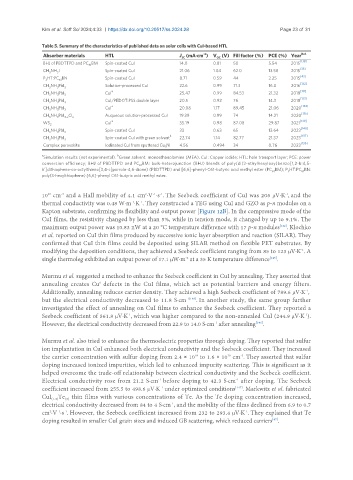
               Table 5. Summary of the characteristics of published data on solar cells with CuI-based HTL
                                                                      -2
                Absorber materials  HTL                       J  (mA·cm ) V  (V) Fill factor (%)  PCE (%) Year Ref.
                                                              SC
                                                                          OC
                BHJ of PBDTTPD and PC BM  Spin-coated CuI     14.0       0.81   50          5.54   2015 [138]
                               61
                                                                                                      [35]
                CH NH I             Spin-coated CuI           21.06      1.04   62.0        13.58  2015
                  3  3
                                                                                                      [43]
                P HT:PC BN          Spin-coated CuI           8.71       0.59   44          2.25   2015
                3
                     61
                                                                                                      [132]
                CH NH PbI           Solution-processed CuI    22.6       0.99   71.3        16.0   2016
                  3  3  3
                                       a                                                              [131]
                CH NH PbI 3         CuI                       25.47      0.99   84.53       21.32  2018
                  3
                    3
                CH NH PbI 3         CuI/PEDOT:PSS double layer  20.5     0.92   76          14.3   2018 [133]
                  3
                    3
                                       a                                                               [134]
                CH NH PbI 3         CuI                       20.08      1.17   89.45       21.06  2020
                    3
                  3
                CH NH PbI Cl x      Auqueous solution-processed CuI  19.39  0.99  74        14.21  2020 [135]
                       3-x
                  3
                    3
                                       a                                                              [139]
                WS                  CuI                       35.19      0.98   87.08       29.87  2021
                  2
                CH NH PbI 3         Spin-coated CuI           33         0.63   65          13.64  2023 [140]
                    3
                  3
                                                          b                                           [137]
                CH NH PbI           Spin-coated CuI with green solvent  22.74  1.14  82.77  21.37  2023
                  3  3  3
                Complex perovskite  Iodinated CuI from sputtered Cu N  4.56  0.494  34      0.76   2023 [136]
                                                         3
               a                         b
                Simulation results (not experimental).  Green solvent: monoethanolamine (MEA). CuI: Copper iodide; HTL: hole transport layer; PCE: power
               conversion  efficiency;  BHJ  of  PBDTTPD  and  PC BM:  bulk-heterojunction  (BHJ)  blends  of  poly(di(2-ethylhexyloxy)benzo[1,2-b:4,5-
                                                61
               b’]dithiophene-co-octylthieno[3,4-c]porrole-4,6-dione) (PBDTTPD) and [6,6]-phenyl-C61-butyric acid methyl ester (PC BM); P HT:PC BN:
                                                                                                       61
                                                                                                  3
                                                                                             61
               poly(3-hexylthiophene):[6,6]-phenyl C61-butyric acid methyl ester.
               10  cm  and a Hall mobility of 4.1 cm ·V ·s . The Seebeck coefficient of CuI was 206 μV·K , and the
                                                  2
                                                                                                 -1
                      -3
                                                     -1 -1
                 20
               thermal conductivity was 0.48 W·m ·K . They constructed a TEG using CuI and GZO as p-n modules on a
                                             -1
                                                -1
               Kapton substrate, confirming its flexibility and output power [Figure 12B]. In the compressive mode of the
               CuI films, the resistivity changed by less than 5%, while in tension mode, it changed by up to 9.1%. The
               maximum output power was 10.83 nW at a 20 °C temperature difference with 17 p-n modules . Klochko
                                                                                               [142]
               et al. reported on CuI thin films produced by successive ionic layer absorption and reaction (SILAR). They
               confirmed that CuI thin films could be deposited using SILAR method on flexible PET substrates. By
               modifying the deposition conditions, they achieved a Seebeck coefficient ranging from 85 to 123 μV·K . A
                                                                                                      -1
               single thermoleg exhibited an output power of 17.1 μW·m  at a 35 K temperature difference .
                                                                -2
                                                                                            [145]
               Murmu et al. suggested a method to enhance the Seebeck coefficient in CuI by annealing. They asserted that
                                   0
               annealing creates Cu  defects in the CuI films, which act as potential barriers and energy filters.
               Additionally, annealing reduces carrier density. They achieved a high Seebeck coefficient of 789.6 μV·K ,
                                                                                                        -1
               but the electrical conductivity decreased to 11.8 S·cm -1[146] . In another study, the same group further
               investigated the effect of annealing on CuI films to enhance the Seebeck coefficient. They reported a
               Seebeck coefficient of 561.8 μV·K , which was higher compared to the non-annealed CuI (244.9 μV·K ).
                                                                                                        -1
                                            -1
                                                                         -1
                                                                                       [146]
               However, the electrical conductivity decreased from 22.9 to 14.0 S·cm  after annealing .
               Murmu et al. also tried to enhance the thermoelectric properties through doping. They reported that sulfur
               ion implantation in CuI enhanced both electrical conductivity and the Seebeck coefficient. They increased
                                                                                  -3
                                                                              20
                                                                   19
               the carrier concentration with sulfur doping from 2.4 × 10  to 1.6 × 10  cm . They asserted that sulfur
               doping increased ionized impurities, which led to enhanced impurity scattering. This is significant as it
               helped overcome the trade-off relationship between electrical conductivity and the Seebeck coefficient.
               Electrical conductivity rose from 21.2 S·cm  before doping to 42.3 S·cm  after doping. The Seebeck
                                                      -1
                                                                                -1
               coefficient increased from 255.5 to 498.6 μV·K  under optimized conditions . Markwitz et al. fabricated
                                                                                [147]
                                                       -1
               CuI Te  thin films with various concentrations of Te. As the Te doping concentration increased,
                  (1-x)
                       (x)
               electrical conductivity decreased from 84 to 4 S·cm , and the mobility of the films declined from 6.9 to 0.7
                                                           -1
               cm ·V ·s . However, the Seebeck coefficient increased from 232 to 293.4 μV·K . They explained that Te
                  2
                    -1 -1
                                                                                    -1
                                                                                             [47]
               doping resulted in smaller CuI grain sizes and induced GB scattering, which reduced carriers .

