


Page 96 - Read Online
P. 96
Page 20 of 31                            Kim et al. Soft Sci 2024;4:33  https://dx.doi.org/10.20517/ss.2024.28


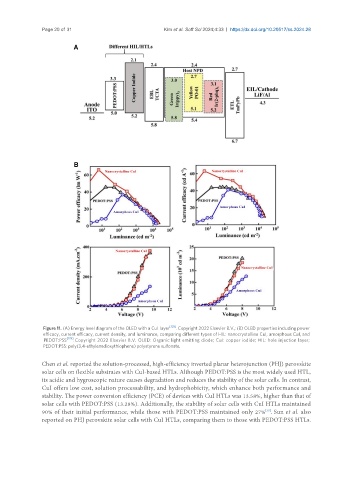
                Figure 11. (A) Energy level diagram of the OLED with a CuI layer [128] . Copyright 2022 Elsevier B.V.; (B) OLED properties including power
                efficacy, current efficacy, current density, and luminance, comparing different types of HIL: nanocrystalline CuI, amorphous CuI, and
                PEDOT:PSS [128] . Copyright 2022 Elsevier B.V. OLED: Organic light emitting diode; CuI: copper iodide; HIL: hole injection layer;
                PEDOT:PSS: poly(3,4-ethylenedioxythiophene) polystyrene sulfonate.


               Chen et al. reported the solution-processed, high-efficiency inverted planar heterojunction (PHJ) perovskite
               solar cells on flexible substrates with CuI-based HTLs. Although PEDOT:PSS is the most widely used HTL,
               its acidic and hygroscopic nature causes degradation and reduces the stability of the solar cells. In contrast,
               CuI offers low cost, solution processability, and hydrophobicity, which enhance both performance and
               stability. The power conversion efficiency (PCE) of devices with CuI HTLs was 13.58%, higher than that of
               solar cells with PEDOT:PSS (13.28%). Additionally, the stability of solar cells with CuI HTLs maintained
                                                                                          [35]
               90% of their initial performance, while those with PEDOT:PSS maintained only 27% . Sun et al. also
               reported on PHJ perovskite solar cells with CuI HTLs, comparing them to those with PEDOT:PSS HTLs.

