


Page 101 - Read Online
P. 101
Kim et al. Soft Sci 2024;4:33  https://dx.doi.org/10.20517/ss.2024.28           Page 25 of 31

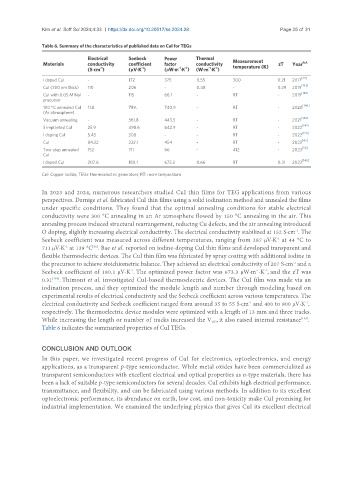
               Table 6. Summary of the characteristics of published data on CuI for TEGs

                               Electrical   Seebeck     Power      Thermal
                Materials      conductivity   coefficient   factor  conductivity   Measurement   zT  Year Ref.
                                                                                temperature (K)
                                                             -1
                                                 -1
                                   -1
                                                               -2
                                                                          -1
                                                                       -1
                               (S·cm )      (μV·K )     (μW·m ·K )  (W·m ·K )
                                                                                                       [27]
                I doped CuI    -            172         375        0.55         300            0.21  2017
                CuI (300 nm thick)  110     206         -          0.48         -              0.29  2019 [142]
                                                                                                       [145]
                CuI with 0.05 M NaI   -     115         66.1       -            RT             -    2019
                precursor
                                                                                                       [146]
                100 °C annealed CuI   11.8  789.        740.9      -            RT             -    2020
                (Ar atmosphere)
                                                                                                       [146]
                Vacuum annealing  -         561.8       443.5      -            RT             -    2021
                S implanted CuI  25.9       498.6       642.9      -            RT             -    2022 [147]
                                                                                                       [150]
                I doping CuI   5.43         308         -          -            RT             -    2022
                                                                                                       [47]
                CuI            84.22        232.1       454        -            RT             -    2023
                Two-step annealed   152     711         66         -            412            -    2023 [56]
                CuI
                I doped CuI    207.6        180.1       673.3      0.66         RT             0.31  2023 [148]
               CuI: Copper iodide; TEGs: thermoelectric generators; RT: room temperature.
               In 2023 and 2024, numerous researchers studied CuI thin films for TEG applications from various
               perspectives. Darnige et al. fabricated CuI thin films using a solid iodination method and annealed the films
               under specific conditions. They found that the optimal annealing conditions for stable electrical
               conductivity were 300 °C annealing in an Ar atmosphere flowed by 150 °C annealing in the air. This
               annealing process induced structural rearrangement, reducing Cu defects, and the air annealing introduced
                                                                                                     -1
               O doping, slightly increasing electrical conductivity. The electrical conductivity stabilized at 152 S·cm . The
               Seebeck coefficient was measured across different temperatures, ranging from 287 μV·K  at 44 °C to
                                                                                              -1
                       -1
               711 μV·K  at 139 °C . Bae et al. reported on iodine-doping CuI thin films and developed transparent and
                                [56]
               flexible thermoelectric devices. The CuI thin film was fabricated by spray coating with additional iodine in
                                                                                                    -1
               the precursor to achieve stoichiometric balance. They achieved an electrical conductivity of 207 S·cm  and a
                                                                                       -1
                                                                                          -2
                                             -1
               Seebeck coefficient of 180.1 μV·K . The optimized power factor was 673.3 μW·m ·K , and the zT was
               0.31 . Thimont et al. investigated CuI-based thermoelectric devices. The CuI film was made via an
                   [148]
               iodination process, and they optimized the module length and number through modeling based on
               experimental results of electrical conductivity and the Seebeck coefficient across various temperatures. The
                                                                                     -1
               electrical conductivity and Seebeck coefficient ranged from around 35 to 55 S·cm  and 400 to 800 μV·K ,
                                                                                                        -1
               respectively. The thermoelectric device modules were optimized with a length of 13 mm and three tracks.
                                                                                                      [149]
               While increasing the length or number of tracks increased the V , it also raised internal resistance .
                                                                        OC
               Table 6 indicates the summarized properties of CuI TEGs.
               CONCLUSION AND OUTLOOK
               In this paper, we investigated recent progress of CuI for electronics, optoelectronics, and energy
               applications, as a transparent p-type semiconductor. While metal oxides have been commercialized as
               transparent semiconductors with excellent electrical and optical properties as n-type materials, there has
               been a lack of suitable p-type semiconductors for several decades. CuI exhibits high electrical performance,
               transmittance, and flexibility, and can be fabricated using various methods. In addition to its excellent
               optoelectronic performance, its abundance on earth, low cost, and non-toxicity make CuI promising for
               industrial implementation. We examined the underlying physics that gives CuI its excellent electrical

