


Page 197 - Read Online
P. 197
Jeon et al. Soft Sci. 2025, 5, 1  https://dx.doi.org/10.20517/ss.2024.35        Page 27 of 39

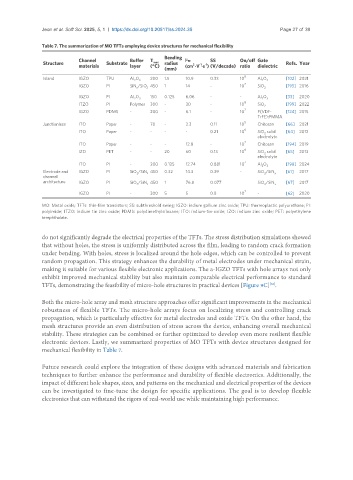
               Table 7. The summarization of MO TFTs employing device structures for mechanical flexibility

                            Channel          Buffer   T     Bending   μ FE  SS    On/off  Gate
                Structure            Substrate       max  radius   2  -1  -1                     Refs. Year
                            materials        layer  (°C)       (cm ·V ·s ) (V/decade) ratio  dielectric
                                                        (mm)
                                                                                   8
                Island      IGZO     TPU     Al O   200  1.5    10.9    0.33      10    Al O     [102] 2021
                                              2  3                                       2  3
                                                                                   7
                            IGZO     PI      SiN /SiO 450  1    14      -         10    SiO 2    [193] 2016
                                               x
                                                  2
                            IGZO     PI      Al O   150  0.125  6.06    -         -     Al O     [33]  2020
                                              2  3                                       2  3
                            ITZO     PI      Polymer  300  -    30      -         10 8  SiO 2    [199] 2022
                                                                                   7
                            IGZO     PDMS    -      200  -      6.1     -         10    P(VDF-   [124] 2015
                                                                                        TrFE):PMMA
                                                                                   5
                Junctionless  ITO    Paper   -      70  -       2.3     0.11      10    Chitosan  [66]  2021
                                                                                   6
                            ITO      Paper   -      -   -       -       0.21      10    SiO  solid   [64]  2012
                                                                                          2
                                                                                        electrolyte
                                                                                   7
                            ITO      Paper   -      -   -       12.8    -         10    Chitosan  [194] 2019
                            IZO      PET     -      -   20      60      0.13      10 6  SiO  solid   [65]  2013
                                                                                          2
                                                                                        electrolyte
                            ITO      PI      -      200  0.125  12.74   0.881     10 7  Al O 3   [198] 2024
                                                                                         2
                Electrode and   IGZO  PI     SiO /SiN x 450  0.32  14.3  0.39     -     SiO /SiN  [61]  2017
                                               2                                          2   x
                channel
                architecture  IGZO   PI      SiO /SiN x 450  1  76.8    0.077           SiO /SiN  [67]  2017
                                               2                                          2   x
                            IGZO     PI      -      300  5      5       0.8       10 7  -        [62]  2020
               MO: Metal oxide; TFTs: thin-film transistors; SS: subthreshold swing; IGZO: indium gallium zinc oxide; TPU: thermoplastic polyurethane; PI:
               polyimide; ITZO: indium tin zinc oxide; PDMS: polydimethylsiloxane; ITO: indium-tin-oxide; IZO: indium zinc oxide; PET: polyethylene
               terephthalate.
               do not significantly degrade the electrical properties of the TFTs. The stress distribution simulations showed
               that without holes, the stress is uniformly distributed across the film, leading to random crack formation
               under bending. With holes, stress is localized around the hole edges, which can be controlled to prevent
               random propagation. This strategy enhances the durability of metal electrodes under mechanical strain,
               making it suitable for various flexible electronic applications. The a-IGZO TFTs with hole arrays not only
               exhibit improved mechanical stability but also maintain comparable electrical performance to standard
               TFTs, demonstrating the feasibility of micro-hole structures in practical devices [Figure 9C] .
                                                                                            [62]

               Both the micro-hole array and mesh structure approaches offer significant improvements in the mechanical
               robustness of flexible TFTs. The micro-hole arrays focus on localizing stress and controlling crack
               propagation, which is particularly effective for metal electrodes and oxide TFTs. On the other hand, the
               mesh structures provide an even distribution of stress across the device, enhancing overall mechanical
               stability. These strategies can be combined or further optimized to develop even more resilient flexible
               electronic devices. Lastly, we summarized properties of MO TFTs with device structures designed for
               mechanical flexibility in Table 7.

               Future research could explore the integration of these designs with advanced materials and fabrication
               techniques to further enhance the performance and durability of flexible electronics. Additionally, the
               impact of different hole shapes, sizes, and patterns on the mechanical and electrical properties of the devices
               can be investigated to fine-tune the design for specific applications. The goal is to develop flexible
               electronics that can withstand the rigors of real-world use while maintaining high performance.

