


Page 200 - Read Online
P. 200
Page 30 of 39                           Jeon et al. Soft Sci. 2025, 5, 1  https://dx.doi.org/10.20517/ss.2024.35


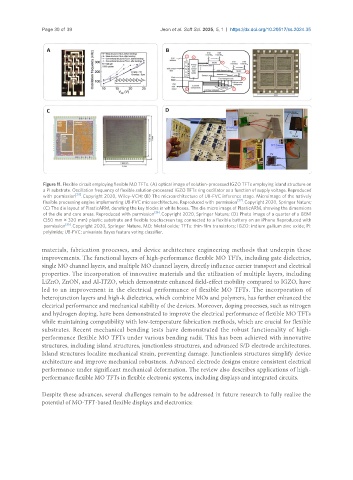
                Figure 11. Flexible circuit employing flexible MO TFTs. (A) optical image of solution-processed IGZO TFTs employing island structure on
                a PI substrate. Oscillation frequency of flexible solution-processed IGZO TFTs ring oscillator as a function of supply voltage. Reproduced
                with  permission [33] . Copyright 2020, Wiley-VCH; (B) The microarchitecture of UB-FVC inference stage. Microimage of the natively
                flexible processing engine implementing UB-FVC microarchitecture. Reproduced with permission [37] . Copyright 2020, Springer Nature;
                (C) The die layout of PlasticARM, denoting the key blocks in white boxes. The die micro image of PlasticARM, showing the dimensions
                of the die and core areas. Reproduced with  permission [36] . Copyright 2020, Springer Nature; (D) Photo image of a quarter of a GEN1
                (350 mm × 320 mm) plastic substrate and flexible touchscreen tag connected to a flexible battery on an iPhone Reproduced with
                permission [35] . Copyright 2020, Springer Nature. MO: Metal oxide; TFTs: thin-film transistors; IGZO: indium gallium zinc oxide; PI:
                polyimide; UB-FVC: univariate Bayes feature voting classifier.


               materials, fabrication processes, and device architecture engineering methods that underpin these
               improvements. The functional layers of high-performance flexible MO TFTs, including gate dielectrics,
               single MO channel layers, and multiple MO channel layers, directly influence carrier transport and electrical
               properties. The incorporation of innovative materials and the utilization of multiple layers, including
               LiZnO, ZnON, and Al-ITZO, which demonstrate enhanced field-effect mobility compared to IGZO, have
               led to an improvement in the electrical performance of flexible MO TFTs. The incorporation of
               heterojunction layers and high-k dielectrics, which combine MOs and polymers, has further enhanced the
               electrical performance and mechanical stability of the devices. Moreover, doping processes, such as nitrogen
               and hydrogen doping, have been demonstrated to improve the electrical performance of flexible MO TFTs
               while maintaining compatibility with low-temperature fabrication methods, which are crucial for flexible
               substrates. Recent mechanical bending tests have demonstrated the robust functionality of high-
               performance flexible MO TFTs under various bending radii. This has been achieved with innovative
               structures, including island structures, junctionless structures, and advanced S/D electrode architectures.
               Island structures localize mechanical strain, preventing damage. Junctionless structures simplify device
               architecture and improve mechanical robustness. Advanced electrode designs ensure consistent electrical
               performance under significant mechanical deformation. The review also describes applications of high-
               performance flexible MO TFTs in flexible electronic systems, including displays and integrated circuits.

               Despite these advances, several challenges remain to be addressed in future research to fully realize the
               potential of MO-TFT-based flexible displays and electronics:

