


Page 199 - Read Online
P. 199
Jeon et al. Soft Sci. 2025, 5, 1  https://dx.doi.org/10.20517/ss.2024.35        Page 29 of 39


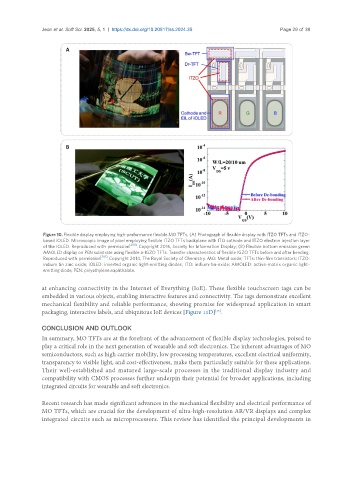
                Figure 10. Flexible display employing high-performance flexible MO TFTs. (A) Photograph of flexible display with ITZO TFTs and ITZO-
                based iOLED. Microscopic image of pixel employing flexible ITZO TFTs backplane with ITO cathode and ITZO electron injection layer
                                             [200]
                of the iOLED. Reproduced with  permission  . Copyright 2016, Society for Information Display; (B) Flexible bottom emission green
                AMOLED display on PEN substrate using flexible a-IGZO TFTs. Transfer characteristics of flexible IGZO TFTs before and after bending.
                Reproduced with permission [201] . Copyright 2014, The Royal Society of Chemistry. MO: Metal oxide; TFTs: thin-film transistors; ITZO:
                indium tin zinc oxide; iOLED: inverted organic light-emitting diodes; ITO: indium-tin-oxide; AMOLED: active-matrix organic light-
                emitting diode; PEN: polyethylene naphthalate.


               at enhancing connectivity in the Internet of Everything (IoE). These flexible touchscreen tags can be
               embedded in various objects, enabling interactive features and connectivity. The tags demonstrate excellent
               mechanical flexibility and reliable performance, showing promise for widespread application in smart
                                                                          [35]
               packaging, interactive labels, and ubiquitous IoE devices [Figure 11D] .
               CONCLUSION AND OUTLOOK
               In summary, MO TFTs are at the forefront of the advancement of flexible display technologies, poised to
               play a critical role in the next generation of wearable and soft electronics. The inherent advantages of MO
               semiconductors, such as high carrier mobility, low processing temperatures, excellent electrical uniformity,
               transparency to visible light, and cost-effectiveness, make them particularly suitable for these applications.
               Their well-established and matured large-scale processes in the traditional display industry and
               compatibility with CMOS processes further underpin their potential for broader applications, including
               integrated circuits for wearable and soft electronics.


               Recent research has made significant advances in the mechanical flexibility and electrical performance of
               MO TFTs, which are crucial for the development of ultra-high-resolution AR/VR displays and complex
               integrated circuits such as microprocessors. This review has identified the principal developments in

