


Page 192 - Read Online
P. 192
Page 22 of 39                           Jeon et al. Soft Sci. 2025, 5, 1  https://dx.doi.org/10.20517/ss.2024.35

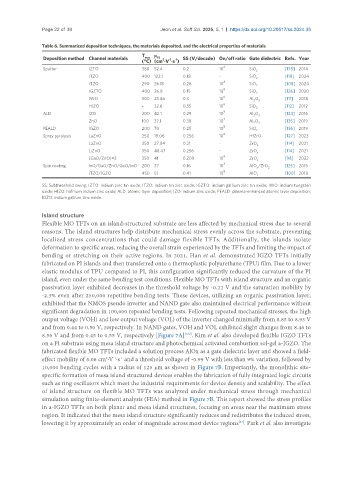
               Table 6. Summarized deposition techniques, the materials deposited, and the electrical properties of materials
                                                 T    μ
                Deposition method Channel materials  max  FE  2  -1  -1  SS (V/decade) On/off ratio Gate dielectric Refs. Year
                                                 (°C) (cm ·V ·s )
                                                                            8
                Sputter        IZTO              380  52.4     0.2         10        SiO         [178] 2014
                                                                                       2
                               ITZO              400 122.1     0.18        -         SiO 2       [118]  2024
                                                                            8
                               ITZO              290  26.15    0.26        10        SiO         [108] 2024
                                                                                       2
                               IGZTO             400 26.8      0.15        10 8      SiO 2       [126] 2020
                                                                            6
                               IWO               300  25.86    0.3         10        Al O        [111]  2018
                                                                                      2  3
                                                                            6
                               HIZO              -   32.6      0.55        10        SiO 2       [112]  2012
                ALD            IZO               200  42.1     0.29        10 9      Al O 3      [134] 2016
                                                                                      2
                                                                            7
                               ZnO               100  37.1     0.38        10        Al O 3      [135] 2019
                                                                                      2
                PEALD          IGZO              200  70       0.25        10 8      SiO 2       [136] 2019
                                                                            8
                Spray pyrolysis  LaZnO           250  19.06    0.256       10        HfZrO       [127] 2023
                               LaZnO             350  27.84    0.21        -         ZrO x       [114]  2021
                               LiZnO             350  48.47    0.256       -         ZrO         [114]  2021
                                                                                        x
                               (GaO/ZnO)×3       350  41       0.209       10 8      ZrO x       [98]  2022
                                                                            4
                Spin coating   InO/GaO/ZnO/GaO/InO  200  37    0.16        10        AlO /ZrO    [125] 2015
                                                                                        x  2
                                                                            8
                               ITZO/IGZO         450  51       0.41        10        AlO x       [100] 2018
               SS: Subthreshold swing; IZTO: indium zinc tin oxide; ITZO: indium tin zinc oxide; IGZTO: indium gallium zinc tin oxide; IWO: indium tungsten
               oxide; HIZO: hafnium indium zinc oxide; ALD: atomic layer deposition; IZO: indium zinc oxide; PEALD: plasma-enhanced atomic layer deposition;
               IGZO: indium gallium zinc oxide.
               Island structure
               Flexible MO TFTs on an island-structured substrate are less affected by mechanical stress due to several
               reasons. The island structures help distribute mechanical stress evenly across the substrate, preventing
               localized stress concentrations that could damage flexible TFTs. Additionally, the islands isolate
               deformation to specific areas, reducing the overall strain experienced by the TFTs and limiting the impact of
               bending or stretching on their active regions. In 2021, Han et al. demonstrated IGZO TFTs initially
               fabricated on PI islands and then transferred onto a thermoplastic polyurethane (TPU) film. Due to a lower
               elastic modulus of TPU compared to PI, this configuration significantly reduced the curvature of the PI
               island, even under the same bending test conditions. Flexible MO TFTs with island structure and an organic
               passivation layer exhibited decreases in the threshold voltage by -0.22 V and the saturation mobility by
               -2.3% even after 250,000 repetitive bending tests. These devices, utilizing an organic passivation layer,
               exhibited that the NMOS pseudo inverter and NAND gate also maintained electrical performance without
               significant degradation in 100,000 repeated bending tests. Following repeated mechanical stresses, the high
               output voltage (VOH) and low output voltage (VOL) of the inverter changed minimally from 8.85 to 8.93 V
               and from 0.44 to 0.50 V, respectively. In NAND gates, VOH and VOL exhibited slight changes from 8.46 to
               8.56 V and from 0.45 to 0.55 V, respectively [Figure 7A] . Kim et al. also developed flexible IGZO TFTs
                                                               [102]
               on a PI substrate using mesa island structure and photochemical activated combustion sol-gel a-IGZO. The
               fabricated flexible MO TFTs included a solution process AlOx as a gate dielectric layer and showed a field-
               effect mobility of 6.06 cm ·V ·s  and a threshold voltage of -0.99 V with less than 9% variation, followed by
                                     2
                                       -1 -1
               10,000 bending cycles with a radius of 125 μm as shown in Figure 7B. Importantly, the monolithic site-
               specific formation of mesa island structured devices enables the fabrication of fully integrated logic circuits
               such as ring oscillators which meet the industrial requirements for device density and scalability. The effect
               of island structure on flexible MO TFTs was analyzed under mechanical stress through mechanical
               simulation using finite-element analysis (FEA) method in Figure 7B. This report showed the stress profiles
               in a-IGZO TFTs on both planar and mesa island structures, focusing on areas near the maximum stress
               region. It indicated that the mesa island structure significantly reduces and redistributes the induced stress,
                                                                                 [33]
               lowering it by approximately an order of magnitude across most device regions . Park et al. also investigate

