


Page 189 - Read Online
P. 189
Jeon et al. Soft Sci. 2025, 5, 1  https://dx.doi.org/10.20517/ss.2024.35        Page 19 of 39

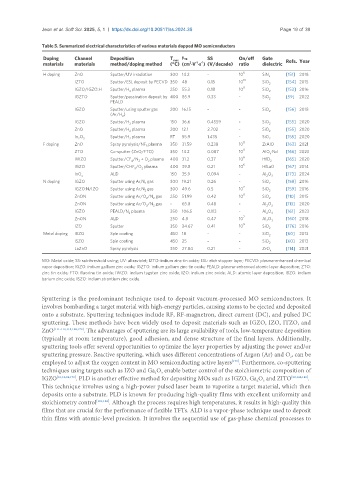
               Table 5. Summarized electrical characteristics of various materials dopped MO semiconductors

                Doping    Channel     Deposition          T max    μ FE  SS       On/off   Gate
                                                                   -1
                                                                     -1
                materials  materials  method/doping method  (°C) (cm ·V ·s ) (V/decade)  ratio  dielectric  Refs. Year
                                                                 2
                H doping  ZnO         Sputter/UV irradiation  300 14.2  -         10 6   SiN x   [151] 2018
                                                                                   10
                          IZTO        Sputter/ESL deposit by PECVD 350 48  0.15   10     SiO     [154] 2015
                                                                                            2
                          IGZO/IGZO:H  Sputter/H  plasma  250 55.3     0.18       10 8   SiO 2   [153] 2016
                                             2
                          IGZTO       Sputter/passivation deposit by  400 85.9  0.33  -  SiO     [59]  2022
                                                                                            2
                                      PEALD
                          IGZO        Sputter/using sputter gas   200 16.15  -    -      SiO     [156] 2018
                                                                                            2
                                      (Ar/H )
                                          2
                          IGZO        Sputter/H  plasma   150  36.6    0.4559     -      SiO     [155] 2020
                                             2                                              2
                          ZnO         Sputter/H  plasma   200 12.1     2.702      -      SiO 2   [155] 2020
                                             2
                          In O 3      Sputter/H  plasma   RT  55.9     1.435      -      SiO 2   [155] 2020
                                             2
                           2
                                                                                   8
                F doping  ZnO         Spray pyrolysis/NF  plasma  350 31.59  0.238  10   ZrAlO   [163] 2021
                                                  3
                          ZTO         Co-sputter (ZnO/FTO)  350 14.2   0.087      10 9   AlO :Nd  [166] 2023
                                                                                            x
                                                                                   6
                          IWZO        Sputter/CF /N  + O  plasma  400 31.2  0.37  10     HfO     [165] 2020
                                             4  2  2                                        2
                          IGZO        Sputter/CHF /O  plasma  400 39.8  0.21      10 6   HfLaO   [167] 2014
                                              3
                                                 2
                          InO         ALD                 150  35.9    0.094      -      Al O    [173] 2024
                            x                                                              2  3
                N doping  IGZO        Sputter using Ar,N  gas  300 19.21  0.26    -      SiO 2   [158] 2016
                                                  2
                                                                                   7
                          IGZO:N/IZO  Sputter using Ar,N  gas  300 49.6  0.5      10     SiO     [159] 2016
                                                  2                                         2
                                                                                   8
                          ZnON        Sputter using Ar/O /N  gas  250 51.99  0.42  10    SiO 2   [110] 2015
                                                     2
                                                  2
                          ZnON        Sputter using Ar/O /N  gas  -  65.8  0.48   -      Al O    [113] 2020
                                                  2  2                                     2  3
                          IGZO        PEALD/N  plasma     350 106.5    0.113      -      Al O 3  [161] 2023
                                                                                           2
                                            2
                          ZnON        ALD                 250 4.8      0.47       10 7   Al O 3  [160] 2018
                                                                                           2
                                                                                   9
                          IZO         Sputter             350 24.67    0.41       10     SiO 2   [176] 2016
                Metal doping  IBZO    Spin coating        450 18       -          -      SiO 2   [60]  2013
                          ISZO        Spin coating        450 25       -          -      SiO     [60]  2013
                                                                                            2
                          LaZnO       Spray pyrolysis     350 27.84    0.21       -      ZrO x   [114] 2021
               MO: Metal oxide; SS: subthreshold swing; UV: ultraviolet; IZTO: indium zinc tin oxide; ESL: etch stopper layer; PECVD: plasma-enhanced chemical
               vapor deposition; IGZO: indium gallium zinc oxide; IGZTO: indium gallium zinc tin oxide; PEALD: plasma-enhanced atomic layer deposition; ZTO:
               zinc tin oxide; FTO: fluorine tin oxide; IWZO: indium tugsten zinc oxide; IZO: indium zinc oxide; ALD: atomic layer deposition; IBZO: indium
               barium zinc oxide; ISZO: indium strontium zinc oxide.
               Sputtering is the predominant technique used to deposit vacuum-processed MO semiconductors. It
               involves bombarding a target material with high-energy particles, causing atoms to be ejected and deposited
               onto a substrate. Sputtering techniques include RF, RF-magnetron, direct current (DC), and pulsed DC
               sputtering. These methods have been widely used to deposit materials such as IGZO, IZO, ITZO, and
               ZnO [111-113,118,126,178] . The advantages of sputtering are its large availability of tools, low-temperature deposition
               (typically at room temperature), good adhesion, and dense structure of the final layers. Additionally,
               sputtering tools offer several opportunities to optimize the layer properties by adjusting the power and/or
               sputtering pressure. Reactive sputtering, which uses different concentrations of Argon (Ar) and O , can be
                                                                                                   2
               employed to adjust the oxygen content in MO semiconducting active layers . Furthermore, co-sputtering
                                                                               [179]
               techniques using targets such as IZO and Ga O  enable better control of the stoichiometric composition of
                                                       3
                                                     2
               IGZO [10,12,94,179] . PLD is another effective method for depositing MOs such as IGZO, Ga O  and ZITO [92,148,180] .
                                                                                        2
                                                                                          3
               This technique involves using a high-power pulsed laser beam to vaporize a target material, which then
               deposits onto a substrate. PLD is known for producing high-quality films with excellent uniformity and
               stoichiometry control [181,182] . Although the process requires high temperatures, it results in high-quality thin
               films that are crucial for the performance of flexible TFTs. ALD is a vapor-phase technique used to deposit
               thin films with atomic-level precision. It involves the sequential use of gas-phase chemical processes to

