


Page 185 - Read Online
P. 185
Jeon et al. Soft Sci. 2025, 5, 1  https://dx.doi.org/10.20517/ss.2024.35        Page 15 of 39

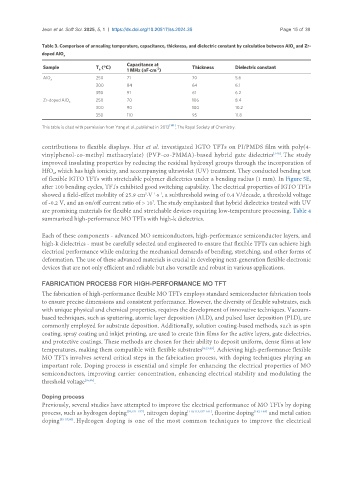
               Table 3. Comparison of annealing temperature, capacitance, thickness, and dielectric constant by calculation between AlO  and Zr-
                                                                                                    x
               doped AlO x
                                            Capacitance at
                Sample           T  (°C)    1 MHz (nF·cm )        Thickness     Dielectric constant
                                                      -2
                                  a
                AlO              250        71                    70            5.6
                  x
                                 300        84                    64            6.1
                                 350        91                    61            6.2
                Zr-doped AlO x   250        70                    106           8.4
                                 300        90                    100           10.2
                                 350        110                   95            11.8
                                                          [141]
               This table is cited with permission from Yang et al., published in 2013  , The Royal Society of Chemistry.

               contributions to flexible displays. Hur et al. investigated IGTO TFTs on PI/PMDS film with poly(4-
                                                                                             [149]
               vinylphenol-co-methyl methacrylate) (PVP-co-PMMA)-based hybrid gate dielectrics . The study
               improved insulating properties by reducing the residual hydroxyl groups through the incorporation of
               HfO , which has high ionicity, and accompanying ultraviolet (UV) treatment. They conducted bending test
                   x
               of flexible IGTO TFTs with stretchable polymer dielectrics under a bending radius (1 mm). In Figure 5E,
               after 100 bending cycles, TFTs exhibited good switching capability. The electrical properties of IGTO TFTs
               showed a field-effect mobility of 25.9 cm ·V ·s , a subthreshold swing of 0.4 V/decade, a threshold voltage
                                                  2
                                                    -1 -1
                                                    7
               of -0.2 V, and an on/off current ratio of > 10 . The study emphasized that hybrid dielectrics treated with UV
               are promising materials for flexible and stretchable devices requiring low-temperature processing. Table 4
               summarized high-performance MO TFTs with high-k dielectrics.

               Each of these components - advanced MO semiconductors, high-performance semiconductor layers, and
               high-k dielectrics - must be carefully selected and engineered to ensure that flexible TFTs can achieve high
               electrical performance while enduring the mechanical demands of bending, stretching, and other forms of
               deformation. The use of these advanced materials is crucial in developing next-generation flexible electronic
               devices that are not only efficient and reliable but also versatile and robust in various applications.

               FABRICATION PROCESS FOR HIGH-PERFORMANCE MO TFT
               The fabrication of high-performance flexible MO TFTs employs standard semiconductor fabrication tools
               to ensure precise dimensions and consistent performance. However, the diversity of flexible substrates, each
               with unique physical and chemical properties, requires the development of innovative techniques. Vacuum-
               based techniques, such as sputtering, atomic layer deposition (ALD), and pulsed laser deposition (PLD), are
               commonly employed for substrate deposition. Additionally, solution coating-based methods, such as spin
               coating, spray coating and inkjet printing, are used to create thin films for the active layers, gate dielectrics,
               and protective coatings. These methods are chosen for their ability to deposit uniform, dense films at low
               temperatures, making them compatible with flexible substrates [8,15,95] . Achieving high-performance flexible
               MO TFTs involves several critical steps in the fabrication process, with doping techniques playing an
               important role. Doping process is essential and simple for enhancing the electrical properties of MO
               semiconductors, improving carrier concentration, enhancing electrical stability and modulating the
               threshold voltage [55,95] .

               Doping process
               Previously, several studies have attempted to improve the electrical performance of MO TFTs by doping
               process, such as hydrogen doping [59,151-157] , nitrogen doping [110,113,157-161] , fluorine doping [162-168]  and metal cation
               doping [55-57,60] . Hydrogen doping is one of the most common techniques to improve the electrical

