


Page 183 - Read Online
P. 183
Jeon et al. Soft Sci. 2025, 5, 1  https://dx.doi.org/10.20517/ss.2024.35        Page 13 of 39

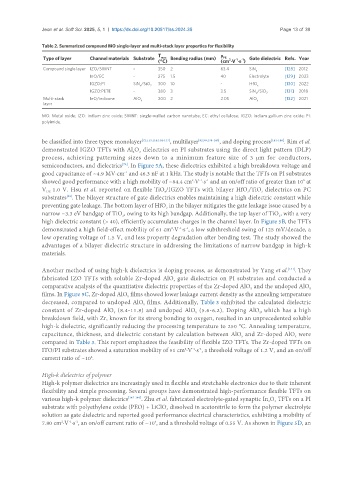
               Table 2. Summarized compound MO single-layer and multi-stack layer properties for flexibility
                                                      T                    μ
                Type of layer  Channel materials Substrate  max  Bending radius (mm)  FE  2  -1  -1  Gate dielectric Refs. Year
                                                      (°C)                 (cm ·V ·s )
                Compound single layer  IZO/SWNT  -    350  2               63.4      SiN         [128] 2012
                                                                                       x
                               InO/EC         -       275  1.5             40        Electrolyte  [129] 2023
                               IGZO:PI        SiN /SiO  300  10            -         HfO         [130] 2022
                                                x   2                                   x
                               IGZO:PETE      -       380  3               3.5       SiN /SiO 2  [131]  2018
                                                                                       x
                Multi-stack    InO/indicone   AlO     200  2               2.05      AlO         [132] 2021
                                                x                                       x
                layer
               MO: Metal oxide; IZO: indium zinc oxide; SWNT: single-walled carbon nanotube; EC: ethyl cellulose; IGZO: indium gallium zinc oxide; PI:
               polyimide.


               be classified into three types: monolayer [72,113,114,134-137] , multilayer [82,98,138-140] , and doping process [141-146] . Rim et al.
               demonstrated IGZO TFTs with Al O  dielectrics on PI substrates using the direct light pattern (DLP)
                                                3
                                              2
               process,  achieving  patterning  sizes  down  to  a  minimum  feature  size  of  3  μm  for  conductors,
               semiconductors, and dielectrics . In Figure 5A, these dielectrics exhibited a high breakdown voltage and
                                          [72]
                                           -1
               good capacitance of ~4.9 MV·cm  and 46.3 nF at 1 kHz. The study is notable that the TFTs on PI substrates
                                                                                                       5
               showed good performance with a high mobility of ~84.4 cm ·V ·s  and an on/off ratio of greater than 10  at
                                                                    -1 -1
                                                                  2
               V  1.0 V. Hsu et al. reported on flexible TiO /IGZO TFTs with bilayer HfO /TiO  dielectrics on PC
                                                                                    2
                                                                                         2
                 DS
                                                        x
               substrates . The bilayer structure of gate dielectrics enables maintaining a high dielectric constant while
                       [82]
               preventing gate leakage. The bottom layer of HfO  in the bilayer mitigates the gate leakage issue caused by a
                                                         2
               narrow ~3.3 eV bandgap of TiO , owing to its high bandgap. Additionally, the top layer of TiO , with a very
                                          2
                                                                                               2
               high dielectric constant (> 40), efficiently accumulates charges in the channel layer. In Figure 5B, the TFTs
                                                             -1 -1
                                                           2
               demonstrated a high field-effect mobility of 61 cm ·V ·s , a low subthreshold swing of 125 mV/decade, a
               low operating voltage of 1.5 V, and less property degradation after bending test. The study showed the
               advantages of a bilayer dielectric structure in addressing the limitations of narrow bandgap in high-k
               materials.
               Another method of using high-k dielectrics is doping process, as demonstrated by Yang et al. . They
                                                                                                  [141]
               fabricated IZO TFTs with soluble Zr-doped AlO  gate dielectrics on PI substrates and conducted a
                                                            x
               comparative analysis of the quantitative dielectric properties of the Zr-doped AlO  and the undoped AlO
                                                                                                         x
                                                                                     x
               films. In Figure 5C, Zr-doped AlO  films showed lower leakage current density as the annealing temperature
                                            x
               decreased, compared to undoped AlO  films. Additionally, Table 3 exhibited the calculated dielectric
                                                 x
               constant of Zr-doped AlO  (8.4-11.8) and undoped AlO  (5.6-6.2). Doping AlO , which has a high
                                                                   x
                                                                                        x
                                       x
               breakdown field, with Zr, known for its strong bonding to oxygen, resulted in an unprecedented soluble
               high-k dielectric, significantly reducing the processing temperature to 250 °C. Annealing temperature,
               capacitance, thickness, and dielectric constant by calculation between AlO  and Zr-doped AlO  were
                                                                                                    x
                                                                                  x
               compared in Table 3. This report emphasizes the feasibility of flexible IZO TFTs. The Zr-doped TFTs on
                                                               2
                                                                  -1 -1
               ITO/PI substrates showed a saturation mobility of 51 cm ·V ·s , a threshold voltage of 1.2 V, and an on/off
               current ratio of ~10 .
                                4
               High-k dielectrics of polymer
               High-k polymer dielectrics are increasingly used in flexible and stretchable electronics due to their inherent
               flexibility and simple processing. Several groups have demonstrated high-performance flexible TFTs on
               various high-k polymer dielectrics [147-149] . Zhu et al. fabricated electrolyte-gated synaptic In O  TFTs on a PI
                                                                                           2
                                                                                              3
               substrate with polyethylene oxide (PEO) + LiClO  dissolved in acetonitrile to form the polymer electrolyte
                                                         4
               solution as gate dielectric and reported good performance electrical characteristics, exhibiting a mobility of
               7.80 cm ·V ·s , an on/off current ratio of ~10 , and a threshold voltage of 0.55 V. As shown in Figure 5D, an
                      2
                        -1 -1
                                                     6

