


Page 181 - Read Online
P. 181
Jeon et al. Soft Sci. 2025, 5, 1  https://dx.doi.org/10.20517/ss.2024.35        Page 11 of 39

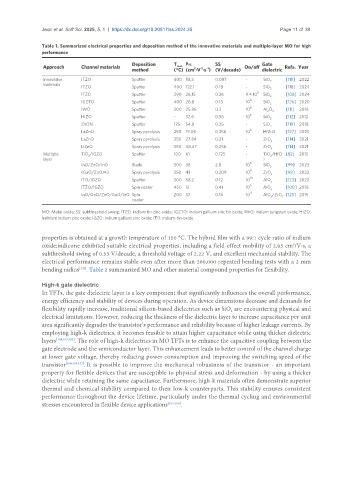
               Table 1. Summarized electrical properties and deposition method of the innovative materials and multiple-layer MO for high
               performance

                                              Deposition    T     μ FE    SS             Gate
                                                             max
                Approach    Channel materials  method       (°C) (cm ·V ·s ) (V/decade)  On/off  dielectric  Refs. Year
                                                                  2
                                                                     -1
                                                                       -1
                Innovative   ITZO             Sputter       400 58.3      0.087     -     SiO    [115] 2022
                                                                                            2
                materials
                            ITZO              Sputter       400 122.1     0.18      -     SiO 2  [118] 2024
                                                                                        8
                            ITZO              Sputter       290 26.15     0.26      9 × 10  SiO  [108] 2024
                                                                                            2
                            IGZTO             Sputter       400 26.8      0.15      10 8  SiO 2  [126] 2020
                                                                                     6
                            IWO               Sputter       300 25.86     0.3       10    Al O   [111]  2018
                                                                                           2  3
                                                                                     6
                            HIZO              Sputter       -   32.6      0.55      10    SiO 2  [112] 2012
                            ZnON              Sputter       175  54.8     0.25      -     SiO    [119] 2018
                                                                                            2
                                                                                     8
                            LaZnO             Spray pyrolysis  250 19.06  0.256     10    HfZrO  [127] 2023
                            LaZnO             Spray pyrolysis  350 27.84  0.21      -     ZrO x  [114] 2021
                            LiZnO             Spray pyrolysis  350 48.47  0.256     -     ZrO    [114] 2021
                                                                                            x
                Multiple    TiO /IGZO         Sputter       100  61       0.125     -     TIO /HfO [82]  2015
                               2
                                                                                            2
                layer                                                                     2
                            InO/ZnO/InO       Blade         300 38        2.8       10 6  SiO 2  [99]  2023
                                                                                     8
                            (GaO/ZnO)×3       Spray pyrolysis  350 41     0.209     10    ZrO    [98]  2022
                                                                                            x
                                                                                     10
                            ITO/IGZO          Sputter       300 58.2      0.12      10    AlO x  [123] 2023
                            ITZO/IGZO         Spin coater   450 51        0.41      10 8  AlO x  [100] 2018
                                                                                     4
                            InO/GaO/ZnO/GaO/InO Spin        200 37        0.16      10    AlO /ZrO [125] 2015
                                                                                            x   2
                                              coater
               MO: Metal oxide; SS: subthreshold swing; ITZO: indium tin zinc oxide; IGZTO: indium gallium zinc tin oxide; IWO: indium tungsten oxide; HIZO:
               hafnium indium zinc oxide; IGZO: indium gallium zinc oxide; ITO: indium-tin-oxide.
               properties is obtained at a growth temperature of 150 °C. The hybrid film with a 99:1 cycle ratio of indium
               oxide:indicone exhibited suitable electrical properties, including a field-effect mobility of 2.05 cm /V·s, a
                                                                                                    2
               subthreshold swing of 0.53 V/decade, a threshold voltage of 2.22 V, and excellent mechanical stability. The
               electrical performance remains stable even after more than 200,000 repeated bending tests with a 2 mm
               bending radius . Table 2 summarized MO and other material compound properties for flexibility.
                            [132]
               High-k gate dielectric
               In TFTs, the gate dielectric layer is a key component that significantly influences the overall performance,
               energy efficiency and stability of devices during operation. As device dimensions decrease and demands for
               flexibility rapidly increase, traditional silicon-based dielectrics such as SiO  are encountering physical and
                                                                               2
               electrical limitations. However, reducing the thickness of the dielectric layer to increase capacitance per unit
               area significantly degrades the transistor’s performance and reliability because of higher leakage currents. By
               employing high-k dielectrics, it becomes feasible to attain higher capacitance while using thicker dielectric
               layers [104,105,133] . The role of high-k dielectrics in MO TFTs is to enhance the capacitive coupling between the
               gate electrode and the semiconductor layer. This enhancement leads to better control of the channel charge
               at lower gate voltage, thereby reducing power consumption and improving the switching speed of the
               transistor [104,105,133] . It is possible to improve the mechanical robustness of the transistor - an important
               property for flexible devices that are susceptible to physical stress and deformation - by using a thicker
               dielectric while retaining the same capacitance. Furthermore, high-k materials often demonstrate superior
               thermal and chemical stability compared to their low-k counterparts. This stability ensures consistent
               performance throughout the device lifetime, particularly under the thermal cycling and environmental
               stresses encountered in flexible device applications [103-105] .

