


Page 147 - Read Online
P. 147
Page 8 of 31                             Lee et al. Soft Sci 2024;4:38  https://dx.doi.org/10.20517/ss.2024.36


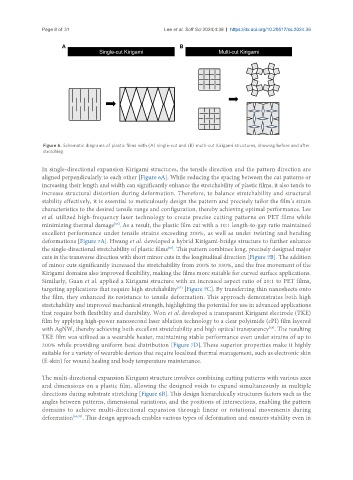
                Figure 6. Schematic diagrams of plastic films with (A) single-cut and (B) multi-cut Kirigami structures, showing before and after
                stretching.

               In single-directional expansion Kirigami structures, the tensile direction and the pattern direction are
               aligned perpendicularly to each other [Figure 6A]. While reducing the spacing between the cut patterns or
               increasing their length and width can significantly enhance the stretchability of plastic films, it also tends to
               increase structural distortion during deformation. Therefore, to balance stretchability and structural
               stability effectively, it is essential to meticulously design the pattern and precisely tailor the film’s strain
               characteristics to the desired tensile range and configuration, thereby achieving optimal performance. Lee
               et al. utilized high-frequency laser technology to create precise cutting patterns on PET films while
               minimizing thermal damage . As a result, the plastic film cut with a 10:1 length-to-gap ratio maintained
                                       [65]
               excellent performance under tensile strains exceeding 200%, as well as under twisting and bending
               deformations [Figure 7A]. Hwang et al. developed a hybrid Kirigami-bridge structure to further enhance
                                                          [66]
               the single-directional stretchability of plastic films . This pattern combines long, precisely designed major
               cuts in the transverse direction with short minor cuts in the longitudinal direction [Figure 7B]. The addition
               of minor cuts significantly increased the stretchability from 200% to 330%, and the free movement of the
               Kirigami domains also improved flexibility, making the films more suitable for curved surface applications.
               Similarly, Guan et al. applied a Kirigami structure with an increased aspect ratio of 20:1 to PET films,
               targeting applications that require high stretchability  [Figure 7C]. By transferring thin nanosheets onto
                                                             [67]
               the film, they enhanced its resistance to tensile deformation. This approach demonstrates both high
               stretchability and improved mechanical strength, highlighting the potential for use in advanced applications
               that require both flexibility and durability. Won et al. developed a transparent Kirigami electrode (TKE)
               film by applying high-power nanosecond laser ablation technology to a clear polyimide (cPI) film layered
               with AgNW, thereby achieving both excellent stretchability and high optical transparency . The resulting
                                                                                            [68]
               TKE film was utilized as a wearable heater, maintaining stable performance even under strains of up to
               200% while providing uniform heat distribution [Figure 7D]. These superior properties make it highly
               suitable for a variety of wearable devices that require localized thermal management, such as electronic skin
               (E-skin) for wound healing and body temperature maintenance.


               The multi-directional expansion Kirigami structure involves combining cutting patterns with various axes
               and dimensions on a plastic film, allowing the designed voids to expand simultaneously in multiple
               directions during substrate stretching [Figure 6B]. This design hierarchically structures factors such as the
               angles between patterns, dimensional variations, and the positions of intersections, enabling the pattern
               domains to achieve multi-directional expansion through linear or rotational movements during
               deformation [69,70] . This design approach enables various types of deformation and ensures stability even in

