


Page 152 - Read Online
P. 152
Lee et al. Soft Sci 2024;4:38  https://dx.doi.org/10.20517/ss.2024.36           Page 13 of 31


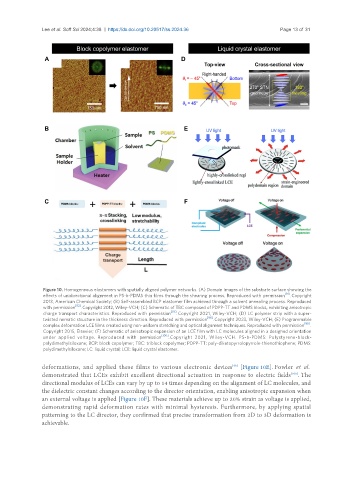
                Figure 10. Homogeneous elastomers with spatially aligned polymer networks. (A) Domain images of the substrate surface showing the
                effects of unidirectional alignment in PS-b-PDMS thin films through the shearing process. Reproduced with  permission [91] . Copyright
                2013, American Chemical Society; (B) Self-assembled BCP elastomer film achieved through a solvent annealing process. Reproduced
                with permission [92] . Copyright 2012, Wiley-VCH; (C) Schematic of TBC composed of PDPP-TT and PDMS blocks, exhibiting anisotropic
                charge transport characteristics. Reproduced with  permission [93] . Copyright 2021, Wiley-VCH; (D) LC polymer strip with a super-
                twisted nematic structure in the thickness direction. Reproduced with  permission [96] . Copyright 2023, Wiley-VCH; (E) Programmable
                complex deformation LCE films created using non-uniform stretching and optical alignment techniques. Reproduced with permission [98] .
                Copyright 2015, Elsevier; (F) Schematic of anisotropic expansion of an LCE film with LC molecules aligned in a designed orientation
                                                       [100]
                under  applied  voltage.  Reproduced  with  permission  . Copyright  2021,  Wiley-VCH.  PS-b-PDMS:  Polystyrene-block-
                polydimethylsiloxane; BCP: block copolymer; TBC: triblock copolymer; PDPP-TT: poly-diketopyrrolopyrrole-thienothiophene; PDMS:
                polydimethylsiloxane; LC: liquid crystal; LCE: liquid crystal elastomer.

               deformations,  and  applied  these  films  to  various  electronic  devices   [Figure 10E]. Fowler  et  al.
                                                                               [98]
                                                                                                   [100]
               demonstrated that LCEs exhibit excellent directional actuation in response to electric fields . The
               directional modulus of LCEs can vary by up to 14 times depending on the alignment of LC molecules, and
               the dielectric constant changes according to the director orientation, enabling anisotropic expansion when
               an external voltage is applied [Figure 10F]. These materials achieve up to 20% strain as voltage is applied,
               demonstrating rapid deformation rates with minimal hysteresis. Furthermore, by applying spatial
               patterning to the LC director, they confirmed that precise transformation from 2D to 3D deformation is
               achievable.

