


Page 148 - Read Online
P. 148
Lee et al. Soft Sci 2024;4:38  https://dx.doi.org/10.20517/ss.2024.36            Page 9 of 31


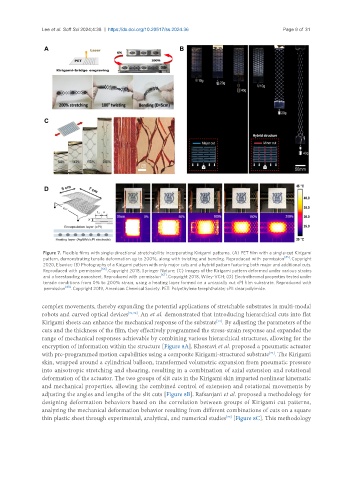
                Figure 7. Flexible films with single-directional stretchability incorporating Kirigami patterns. (A) PET film with a single-cut Kirigami
                pattern, demonstrating tensile deformation up to 200%, along with twisting and bending. Reproduced with  permission [65] . Copyright
                2020, Elsevier; (B) Photographs of a Kirigami pattern with only major cuts and a hybrid pattern featuring both major and additional cuts.
                Reproduced with  permission [66] . Copyright 2018, Springer Nature; (C) Images of the Kirigami pattern deformed under various strains
                and a freestanding nanosheet. Reproduced with permission [67] . Copyright 2018, Wiley-VCH; (D) Electrothermal properties tested under
                tensile conditions from 0% to 200% strain, using a heating layer formed on a uniaxially cut cPI film substrate. Reproduced with
                permission [68] . Copyright 2019, American Chemical Society. PET: Polyethylene terephthalate; cPI: clear polyimide.


               complex movements, thereby expanding the potential applications of stretchable substrates in multi-modal
               robots and curved optical devices [71,72] . An et al. demonstrated that introducing hierarchical cuts into flat
                                                                          [73]
               Kirigami sheets can enhance the mechanical response of the substrate . By adjusting the parameters of the
               cuts and the thickness of the film, they effectively programmed the stress-strain response and expanded the
               range of mechanical responses achievable by combining various hierarchical structures, allowing for the
               encryption of information within the structure [Figure 8A]. Khosravi et al. proposed a pneumatic actuator
               with pre-programmed motion capabilities using a composite Kirigami-structured substrate . The Kirigami
                                                                                            [74]
               skin, wrapped around a cylindrical balloon, transformed volumetric expansion from pneumatic pressure
               into anisotropic stretching and shearing, resulting in a combination of axial extension and rotational
               deformation of the actuator. The two groups of slit cuts in the Kirigami skin imparted nonlinear kinematic
               and mechanical properties, allowing the combined control of extension and rotational movements by
               adjusting the angles and lengths of the slit cuts [Figure 8B]. Rafsanjani et al. proposed a methodology for
               designing deformation behaviors based on the correlation between groups of Kirigami cut patterns,
               analyzing the mechanical deformation behavior resulting from different combinations of cuts on a square
               thin plastic sheet through experimental, analytical, and numerical studies  [Figure 8C]. This methodology
                                                                             [75]

