


Page 146 - Read Online
P. 146
Lee et al. Soft Sci 2024;4:38  https://dx.doi.org/10.20517/ss.2024.36            Page 7 of 31


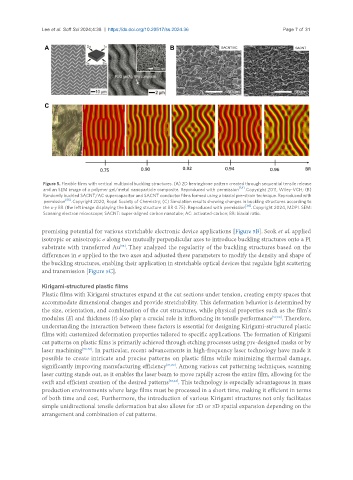
                Figure 5. Flexible films with vertical multiaxial buckling structures. (A) 2D herringbone pattern created through sequential tensile release
                and an SEM image of a polymer gel/metal nanoparticle composite. Reproduced with  permission [54] . Copyright 2011, Wiley-VCH; (B)
                Randomly buckled SACNT/AC supercapacitor and SACNT conductor films formed using a biaxial pre-strain technique. Reproduced with
                permission [55] . Copyright 2020, Royal Society of Chemistry; (C) Simulation results showing changes in buckling structures according to
                the x-y BR (the left image displaying the buckling structure at BR 0.75). Reproduced with permission [56] . Copyright 2024, MDPI. SEM:
                Scanning electron microscope; SACNT: super-aligned carbon nanotube; AC: activated-carbon; BR: biaxial ratio.


               promising potential for various stretchable electronic device applications [Figure 5B]. Seok et al. applied
               isotropic or anisotropic σ along two mutually perpendicular axes to introduce buckling structures onto a PI
               substrate with transferred Au . They analyzed the regularity of the buckling structures based on the
                                         [56]
               differences in σ applied to the two axes and adjusted these parameters to modify the density and shape of
               the buckling structures, enabling their application in stretchable optical devices that regulate light scattering
               and transmission [Figure 5C].


               Kirigami-structured plastic films
               Plastic films with Kirigami structures expand at the cut sections under tension, creating empty spaces that
               accommodate dimensional changes and provide stretchability. This deformation behavior is determined by
               the size, orientation, and combination of the cut structures, while physical properties such as the film’s
               modulus (E) and thickness (t) also play a crucial role in influencing its tensile performance [57,58] . Therefore,
               understanding the interaction between these factors is essential for designing Kirigami-structured plastic
               films with customized deformation properties tailored to specific applications. The formation of Kirigami
               cut patterns on plastic films is primarily achieved through etching processes using pre-designed masks or by
               laser machining [59-63] . In particular, recent advancements in high-frequency laser technology have made it
               possible to create intricate and precise patterns on plastic films while minimizing thermal damage,
               significantly improving manufacturing efficiency [61,62] . Among various cut patterning techniques, scanning
               laser cutting stands out, as it enables the laser beam to move rapidly across the entire film, allowing for the
               swift and efficient creation of the desired patterns [63,64] . This technology is especially advantageous in mass
               production environments where large films must be processed in a short time, making it efficient in terms
               of both time and cost. Furthermore, the introduction of various Kirigami structures not only facilitates
               simple unidirectional tensile deformation but also allows for 2D or 3D spatial expansion depending on the
               arrangement and combination of cut patterns.

