


Page 142 - Read Online
P. 142
Lee et al. Soft Sci 2024;4:38  https://dx.doi.org/10.20517/ss.2024.36            Page 3 of 31


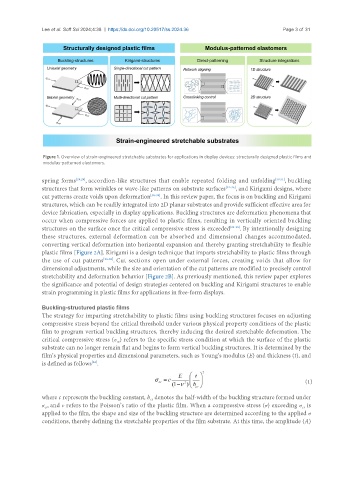
                Figure 1. Overview of strain-engineered stretchable substrates for applications in display devices: structurally designed plastic films and
                modulus-patterned elastomers.

               spring forms [28,29] , accordion-like structures that enable repeated folding and unfolding [30,31] , buckling
               structures that form wrinkles or wave-like patterns on substrate surfaces [32-35] , and Kirigami designs, where
               cut patterns create voids upon deformation [36-39] . In this review paper, the focus is on buckling and Kirigami
               structures, which can be readily integrated into 2D planar substrates and provide sufficient effective area for
               device fabrication, especially in display applications. Buckling structures are deformation phenomena that
               occur when compressive forces are applied to plastic films, resulting in vertically oriented buckling
               structures on the surface once the critical compressive stress is exceeded [32-35] . By intentionally designing
               these structures, external deformation can be absorbed and dimensional changes accommodated,
               converting vertical deformation into horizontal expansion and thereby granting stretchability to flexible
               plastic films [Figure 2A]. Kirigami is a design technique that imparts stretchability to plastic films through
               the use of cut patterns [36-39] . Cut sections open under external forces, creating voids that allow for
               dimensional adjustments, while the size and orientation of the cut patterns are modified to precisely control
               stretchability and deformation behavior [Figure 2B]. As previously mentioned, this review paper explores
               the significance and potential of design strategies centered on buckling and Kirigami structures to enable
               strain programming in plastic films for applications in free-form displays.

               Buckling-structured plastic films
               The strategy for imparting stretchability to plastic films using buckling structures focuses on adjusting
               compressive stress beyond the critical threshold under various physical property conditions of the plastic
               film to program vertical buckling structures, thereby inducing the desired stretchable deformation. The
               critical compressive stress (σ ) refers to the specific stress condition at which the surface of the plastic
                                        cr
               substrate can no longer remain flat and begins to form vertical buckling structures. It is determined by the
               film’s physical properties and dimensional parameters, such as Young’s modulus (E) and thickness (t), and
               is defined as follows .
                                [32]

                                                                                                        (1)

               where c represents the buckling constant, b  denotes the half-width of the buckling structure formed under
                                                    cr
               σ , and ν refers to the Poisson’s ratio of the plastic film. When a compressive stress (σ) exceeding σ  is
                                                                                                       cr
                cr
               applied to the film, the shape and size of the buckling structure are determined according to the applied σ
               conditions, thereby defining the stretchable properties of the film substrate. At this time, the amplitude (A)

