


Page 145 - Read Online
P. 145
Page 6 of 31                             Lee et al. Soft Sci 2024;4:38  https://dx.doi.org/10.20517/ss.2024.36


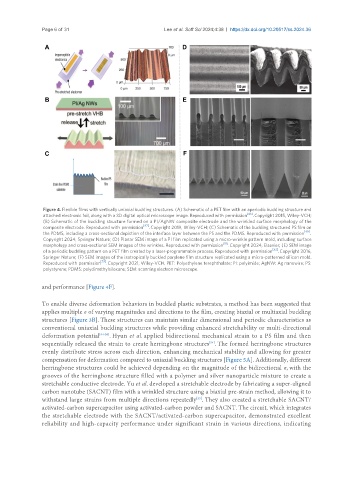
                Figure 4. Flexible films with vertically uniaxial buckling structures. (A) Schematic of a PET film with an aperiodic buckling structure and
                                                                                    [45]
                attached electronic foil, along with a 3D digital optical microscope image. Reproduced with permission  . Copyright 2015, Wiley-VCH;
                (B) Schematic of the buckling structure formed on a PI/AgNW composite electrode and the wrinkled surface morphology of the
                                                 [47]
                composite electrode. Reproduced with permission  . Copyright 2019, Wiley-VCH; (C) Schematic of the buckling structured PS film on
                                                                                                        [49]
                the PDMS, including a cross-sectional depiction of the interface layer between the PS and the PDMS. Reproduced with  permission  .
                Copyright 2024, Springer Nature; (D) Planar SEM image of a PI film replicated using a micro-wrinkle pattern mold, including surface
                                                                            [51]
                morphology and cross-sectional SEM images of the wrinkles. Reproduced with permission  . Copyright 2024, Elsevier; (E) SEM image
                                                                                             [52]
                of a periodic buckling pattern on a PET film created by a laser-programmable process. Reproduced with permission  . Copyright 2016,
                Springer Nature; (F) SEM images of the isotropically buckled parylene film structure replicated using a micro-patterned silicon mold.
                Reproduced with permission [53] . Copyright 2021, Wiley-VCH. PET: Polyethylene terephthalate; PI: polyimide; AgNW: Ag nanowire; PS:
                polystyrene; PDMS: polydimethylsiloxane; SEM: scanning electron microscope.
               and performance [Figure 4F].

               To enable diverse deformation behaviors in buckled plastic substrates, a method has been suggested that
               applies multiple σ of varying magnitudes and directions to the film, creating biaxial or multiaxial buckling
               structures [Figure 3B]. These structures can maintain similar dimensional and periodic characteristics as
               conventional uniaxial buckling structures while providing enhanced stretchability or multi-directional
               deformation potential [54-56] . Hyun et al. applied bidirectional mechanical strain to a PS film and then
                                                                        [54]
               sequentially released the strain to create herringbone structures . The formed herringbone structures
               evenly distribute stress across each direction, enhancing mechanical stability and allowing for greater
               compensation for deformation compared to uniaxial buckling structures [Figure 5A]. Additionally, different
               herringbone structures could be achieved depending on the magnitude of the bidirectional σ, with the
               grooves of the herringbone structure filled with a polymer and silver nanoparticle mixture to create a
               stretchable conductive electrode. Yu et al. developed a stretchable electrode by fabricating a super-aligned
               carbon nanotube (SACNT) film with a wrinkled structure using a biaxial pre-strain method, allowing it to
               withstand large strains from multiple directions repeatedly . They also created a stretchable SACNT/
                                                                   [55]
               activated-carbon supercapacitor using activated-carbon powder and SACNT. The circuit, which integrates
               the stretchable electrode with the SACNT/activated-carbon supercapacitor, demonstrated excellent
               reliability and high-capacity performance under significant strain in various directions, indicating

