


Page 151 - Read Online
P. 151
Page 12 of 31                            Lee et al. Soft Sci 2024;4:38  https://dx.doi.org/10.20517/ss.2024.36


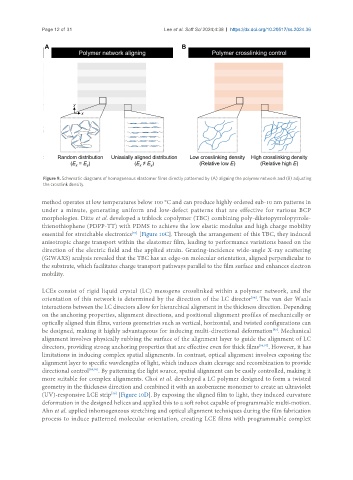
                Figure 9. Schematic diagrams of homogeneous elastomer films directly patterned by (A) aligning the polymer network and (B) adjusting
                the crosslink density.


               method operates at low temperatures below 100 °C and can produce highly ordered sub-10 nm patterns in
               under a minute, generating uniform and low-defect patterns that are effective for various BCP
               morphologies. Ditte et al. developed a triblock copolymer (TBC) combining poly-diketopyrrolopyrrole-
               thienothiophene (PDPP-TT) with PDMS to achieve the low elastic modulus and high charge mobility
                                             [93]
               essential for stretchable electronics  [Figure 10C]. Through the arrangement of this TBC, they induced
               anisotropic charge transport within the elastomer film, leading to performance variations based on the
               direction of the electric field and the applied strain. Grazing-incidence wide-angle X-ray scattering
               (GIWAXS) analysis revealed that the TBC has an edge-on molecular orientation, aligned perpendicular to
               the substrate, which facilitates charge transport pathways parallel to the film surface and enhances electron
               mobility.

               LCEs consist of rigid liquid crystal (LC) mesogens crosslinked within a polymer network, and the
                                                                                      [94]
               orientation of this network is determined by the direction of the LC director . The van der Waals
               interactions between the LC directors allow for hierarchical alignment in the thickness direction. Depending
               on the anchoring properties, alignment directions, and positional alignment profiles of mechanically or
               optically aligned thin films, various geometries such as vertical, horizontal, and twisted configurations can
               be designed, making it highly advantageous for inducing multi-directional deformation . Mechanical
                                                                                             [95]
               alignment involves physically rubbing the surface of the alignment layer to guide the alignment of LC
               directors, providing strong anchoring properties that are effective even for thick films [96,97] . However, it has
               limitations in inducing complex spatial alignments. In contrast, optical alignment involves exposing the
               alignment layer to specific wavelengths of light, which induces chain cleavage and recombination to provide
               directional control [98,99] . By patterning the light source, spatial alignment can be easily controlled, making it
               more suitable for complex alignments. Choi et al. developed a LC polymer designed to form a twisted
               geometry in the thickness direction and combined it with an azobenzene monomer to create an ultraviolet
                                       [96]
               (UV)-responsive LCE strip  [Figure 10D]. By exposing the aligned film to light, they induced curvature
               deformation in the designed helices and applied this to a soft robot capable of programmable multi-motion.
               Ahn et al. applied inhomogeneous stretching and optical alignment techniques during the film fabrication
               process to induce patterned molecular orientation, creating LCE films with programmable complex

