


Page 156 - Read Online
P. 156
Lee et al. Soft Sci 2024;4:38  https://dx.doi.org/10.20517/ss.2024.36           Page 17 of 31


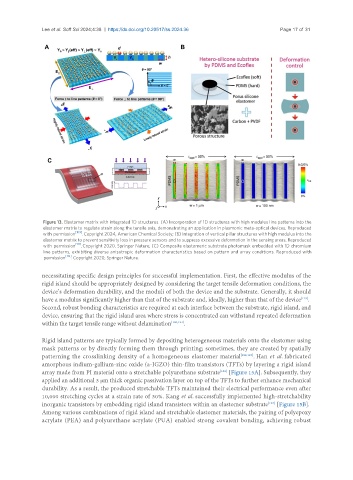
                Figure 13. Elastomer matrix with integrated 1D structures. (A) Incorporation of 1D structures with high modulus line patterns into the
                elastomer matrix to regulate strain along the tensile axis, demonstrating an application in plasmonic meta-optical devices. Reproduced
                          [109]
                with permission  . Copyright 2024, American Chemical Society; (B) Integration of vertical pillar structures with high modulus into the
                elastomer matrix to prevent sensitivity loss in pressure sensors and to suppress excessive deformation in the sensing areas. Reproduced
                          [111]
                with  permission  . Copyright 2020, Springer Nature; (C) Composite elastomeric substrate photomask embedded with 1D chromium
                line patterns, exhibiting diverse anisotropic deformation characteristics based on pattern and array conditions. Reproduced with
                       [112]
                permission  . Copyright 2020, Springer Nature.
               necessitating specific design principles for successful implementation. First, the effective modulus of the
               rigid island should be appropriately designed by considering the target tensile deformation conditions, the
               device’s deformation durability, and the moduli of both the device and the substrate. Generally, it should
                                                                                                      [119]
               have a modulus significantly higher than that of the substrate and, ideally, higher than that of the device .
               Second, robust bonding characteristics are required at each interface between the substrate, rigid island, and
               device, ensuring that the rigid island area where stress is concentrated can withstand repeated deformation
               within the target tensile range without delamination [120,121] .


               Rigid island patterns are typically formed by depositing heterogeneous materials onto the elastomer using
               mask patterns or by directly forming them through printing; sometimes, they are created by spatially
               patterning the crosslinking density of a homogeneous elastomer material [122,123] . Han et al. fabricated
               amorphous indium-gallium-zinc oxide (a-IGZO) thin-film transistors (TFTs) by layering a rigid island
               array made from PI material onto a stretchable polyurethane substrate  [Figure 15A]. Subsequently, they
                                                                           [122]
               applied an additional 3 μm thick organic passivation layer on top of the TFTs to further enhance mechanical
               durability. As a result, the produced stretchable TFTs maintained their electrical performance even after
               10,000 stretching cycles at a strain rate of 30%. Kang et al. successfully implemented high-stretchability
                                                                                           [123]
               inorganic transistors by embedding rigid island transistors within an elastomer substrate  [Figure 15B].
               Among various combinations of rigid island and stretchable elastomer materials, the pairing of polyepoxy
               acrylate (PEA) and polyurethane acrylate (PUA) enabled strong covalent bonding, achieving robust

