


Page 160 - Read Online
P. 160
Lee et al. Soft Sci 2024;4:38  https://dx.doi.org/10.20517/ss.2024.36           Page 21 of 31

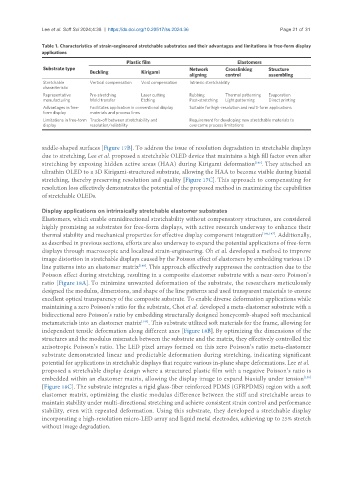
               Table 1. Characteristics of strain-engineered stretchable substrates and their advantages and limitations in free-form display
               applications
                                            Plastic film                         Elastomers
                Substrate type                                   Network     Crosslinking   Structure
                               Buckling          Kirigami
                                                                 aligning    control        assembling
                Stretchable    Vertical compensation  Void compensation  Intrinsic stretchability
                characteristic
                Representative   Pre-stretching   Laser cutting   Rubbing    Thermal patterning   Evaporation
                manufacturing  Mold transfer     Etching         Post-stretching  Light patterning  Direct printing
                Advantages in free-  Facilitates application in conventional display   Suitable for high-resolution and multi-form applications
                form display   materials and process lines
                Limitations in free-form  Trade-off between stretchability and   Requirement for developing new stretchable materials to
                display        resolution/reliability            overcome process limitations


               saddle-shaped surfaces [Figure 17B]. To address the issue of resolution degradation in stretchable displays
               due to stretching, Lee et al. proposed a stretchable OLED device that maintains a high fill factor even after
               stretching by exposing hidden active areas (HAA) during Kirigami deformation . They attached an
                                                                                       [145]
               ultrathin OLED to a 3D Kirigami-structured substrate, allowing the HAA to become visible during biaxial
               stretching, thereby preserving resolution and quality [Figure 17C]. This approach to compensating for
               resolution loss effectively demonstrates the potential of the proposed method in maximizing the capabilities
               of stretchable OLEDs.


               Display applications on intrinsically stretchable elastomer substrates
               Elastomers, which enable omnidirectional stretchability without compensatory structures, are considered
               highly promising as substrates for free-form displays, with active research underway to enhance their
               thermal stability and mechanical properties for effective display component integration [146,147] . Additionally,
               as described in previous sections, efforts are also underway to expand the potential applications of free-form
               displays through macroscopic and localized strain-engineering. Oh et al. developed a method to improve
               image distortion in stretchable displays caused by the Poisson effect of elastomers by embedding various 1D
               line patterns into an elastomer matrix . This approach effectively suppresses the contraction due to the
                                                [148]
               Poisson effect during stretching, resulting in a composite elastomer substrate with a near-zero Poisson’s
               ratio [Figure 18A]. To minimize unwanted deformation of the substrate, the researchers meticulously
               designed the modulus, dimensions, and shape of the line patterns and used transparent materials to ensure
               excellent optical transparency of the composite substrate. To enable diverse deformation applications while
               maintaining a zero Poisson’s ratio for the substrate, Choi et al. developed a meta-elastomer substrate with a
               bidirectional zero Poisson’s ratio by embedding structurally designed honeycomb-shaped soft mechanical
                                                 [149]
               metamaterials into an elastomer matrix . This substrate utilized soft materials for the frame, allowing for
               independent tensile deformation along different axes [Figure 18B]. By optimizing the dimensions of the
               structures and the modulus mismatch between the substrate and the matrix, they effectively controlled the
               anisotropic Poisson’s ratio. The LED pixel arrays formed on this zero Poisson’s ratio meta-elastomer
               substrate demonstrated linear and predictable deformation during stretching, indicating significant
               potential for applications in stretchable displays that require various in-plane shape deformations. Lee et al.
               proposed a stretchable display design where a structured plastic film with a negative Poisson’s ratio is
                                                                                                       [150]
               embedded within an elastomer matrix, allowing the display image to expand biaxially under tension
               [Figure 18C]. The substrate integrates a rigid glass-fiber reinforced PDMS (GFRPDMS) region with a soft
               elastomer matrix, optimizing the elastic modulus difference between the stiff and stretchable areas to
               maintain stability under multi-directional stretching and achieve consistent strain control and performance
               stability, even with repeated deformation. Using this substrate, they developed a stretchable display
               incorporating a high-resolution micro-LED array and liquid metal electrodes, achieving up to 25% stretch
               without image degradation.

