


Page 162 - Read Online
P. 162
Lee et al. Soft Sci 2024;4:38  https://dx.doi.org/10.20517/ss.2024.36           Page 23 of 31


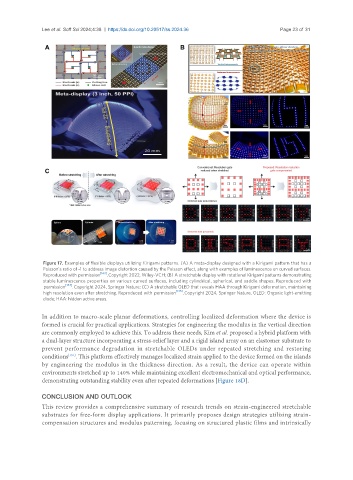
                Figure 17. Examples of flexible displays utilizing Kirigami patterns. (A) A meta-display designed with a Kirigami pattern that has a
                Poisson’s ratio of -1 to address image distortion caused by the Poisson effect, along with examples of luminescence on curved surfaces.
                                   [143]
                Reproduced with permission  . Copyright 2022, Wiley-VCH; (B) A stretchable display with rotational Kirigami patterns demonstrating
                stable luminescence properties on various curved surfaces, including cylindrical, spherical, and saddle shapes. Reproduced with
                       [144]
                permission  . Copyright 2024, Springer Nature; (C) A stretchable OLED that reveals HAA through Kirigami deformation, maintaining
                                                            [145]
                high resolution even after stretching. Reproduced with permission  . Copyright 2024, Springer Nature. OLED: Organic light-emitting
                diode; HAA: hidden active areas.
               In addition to macro-scale planar deformations, controlling localized deformation where the device is
               formed is crucial for practical applications. Strategies for engineering the modulus in the vertical direction
               are commonly employed to achieve this. To address these needs, Kim et al. proposed a hybrid platform with
               a dual-layer structure incorporating a stress-relief layer and a rigid island array on an elastomer substrate to
               prevent performance degradation in stretchable OLEDs under repeated stretching and restoring
               conditions . This platform effectively manages localized strain applied to the device formed on the islands
                        [151]
               by engineering the modulus in the thickness direction. As a result, the device can operate within
               environments stretched up to 140% while maintaining excellent electromechanical and optical performance,
               demonstrating outstanding stability even after repeated deformations [Figure 18D].


               CONCLUSION AND OUTLOOK
               This review provides a comprehensive summary of research trends on strain-engineered stretchable
               substrates for free-form display applications. It primarily proposes design strategies utilizing strain-
               compensation structures and modulus patterning, focusing on structured plastic films and intrinsically

