


Page 31 - Read Online
P. 31
Blewitt et al. Soft Sci 2024;4:13  https://dx.doi.org/10.20517/ss.2023.49       Page 13 of 26


                                                        [36]
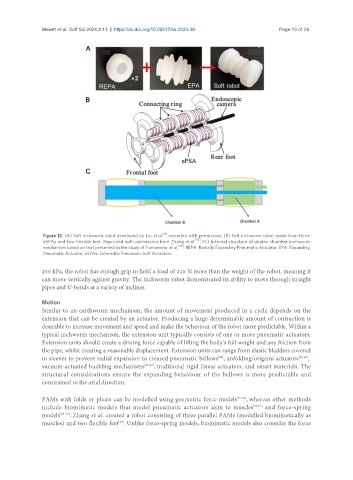
                Figure 12. (A) Soft inchworm robot developed by Liu  et al. , reprinted with permission; (B) Soft inchworm robot made from three
                eSPAs and two flexible feet. Reprinted with permission from Zhang  et al. [55] ; (C) Internal structure of duplex chamber inchworm
                                                             [58]
                mechanism based on that presented in the study of Yamamoto et al.  . REPA: Radially Expanding Pneumatic Actuator; EPA: Expanding
                Pneumatic Actuator; eSPAs: Extensible Pneumatic Soft Actuators.
               250 kPa, the robot has enough grip to hold a load of 240 N more than the weight of the robot, meaning it
               can move vertically against gravity. The inchworm robot demonstrated its ability to move through straight
               pipes and U-bends at a variety of inclines.

               Motion
               Similar to an earthworm mechanism, the amount of movement produced in a cycle depends on the
               extension that can be created by an actuator. Producing a large determinable amount of contraction is
               desirable to increase movement and speed and make the behaviour of the robot more predictable. Within a
               typical inchworm mechanism, the extension unit typically consists of one or more pneumatic actuators.
               Extension units should create a driving force capable of lifting the body’s full weight and any friction from
               the pipe, whilst creating a reasonable displacement. Extension units can range from elastic bladders covered
               in sleeves to prevent radial expansion to creased pneumatic bellows , unfolding/origami actuators [47,48] ,
                                                                          [44]
               vacuum-actuated buckling mechanisms [49,50] , traditional rigid linear actuators, and smart materials. The
               structural considerations ensure the expanding behaviour of the bellows is more predictable and
               constrained to the axial direction.

               PAMs with folds or pleats can be modelled using geometric force models [51,52] , whereas other methods
               include biomimetic models that model pneumatic actuators akin to muscles [53,54]  and force-spring
               models [55-57] . Zhang et al. created a robot consisting of three parallel PAMs (modelled biomimetically as
               muscles) and two flexible feet . Unlike force-spring models, biomimetic models also consider the force
                                         [55]

