


Page 30 - Read Online
P. 30
Page 12 of 26                          Blewitt et al. Soft Sci 2024;4:13  https://dx.doi.org/10.20517/ss.2023.49


                                  Figure 10. Diagram of longitudinal and latitudinal stress on a thin-walled cylinder.


                                                                                     [46]
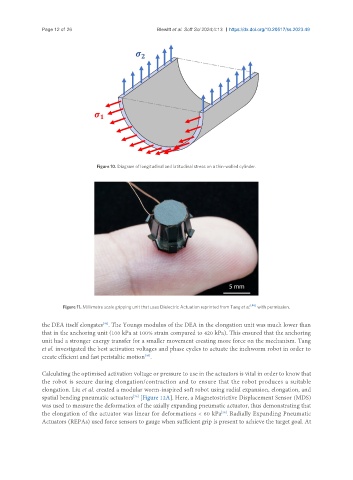
                      Figure 11. Millimetre scale gripping unit that uses Dielectric Actuation reprinted from Tang et al.   with permission.

               the DEA itself elongates . The Youngs modulus of the DEA in the elongation unit was much lower than
                                    [46]
               that in the anchoring unit (100 kPa at 100% strain compared to 420 kPa). This ensured that the anchoring
               unit had a stronger energy transfer for a smaller movement creating more force on the mechanism. Tang
               et al. investigated the best activation voltages and phase cycles to actuate the inchworm robot in order to
                                                  [46]
               create efficient and fast peristaltic motion .

               Calculating the optimised activation voltage or pressure to use in the actuators is vital in order to know that
               the robot is secure during elongation/contraction and to ensure that the robot produces a suitable
               elongation. Liu et al. created a modular worm-inspired soft robot using radial expansion, elongation, and
                                              [36]
               spatial bending pneumatic actuators  [Figure 12A]. Here, a Magnetostrictive Displacement Sensor (MDS)
               was used to measure the deformation of the axially expanding pneumatic actuator, thus demonstrating that
                                                                            [36]
               the elongation of the actuator was linear for deformations < 60 kPa . Radially Expanding Pneumatic
               Actuators (REPAs) used force sensors to gauge when sufficient grip is present to achieve the target goal. At

