


Page 35 - Read Online
P. 35
Blewitt et al. Soft Sci 2024;4:13  https://dx.doi.org/10.20517/ss.2023.49       Page 17 of 26

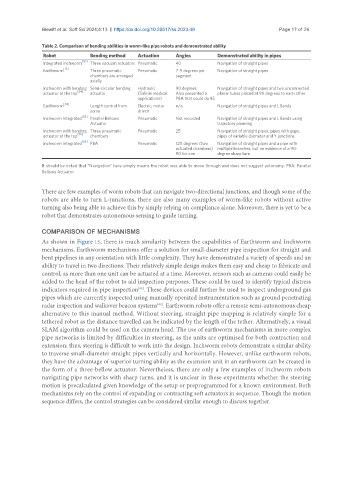
               Table 2. Comparison of bending abilities in worm-like pipe robots and demonstrated ability
                Robot          Bending method  Actuation    Angles        Demonstrated ability in pipes
                Integrated inchworm [50]  Three vacuum actuators Pneumatic  40  Navigation of straight pipes
                      [13]
                Earthworm      Three pneumatic   Pneumatic  7-9 degrees per   Navigation of straight pipes
                               chambers are arranged        segment
                               axially
                Inchworm with bending  Semi-circular bending   Hydraulic   90 degrees   Navigation of straight pipes and two unconnected
                actuator at the top [64]  actuator  (Safe in medical   Also presented a   planar tubes placed at 90 degrees to each other
                                               applications)  PBA that could do 85
                Earthworm [34]  Length control from  Electric, motor   n/a  Navigation of straight pipes and L Bends
                               servo           driven
                Inchworm Integrated [55]  Parallel Bellows   Pneumatic   Not recorded  Navigation of straight pipes and L Bends using
                               Actuator                                   trajectory planning
                Inchworm with bending Three pneumatic   Pneumatic  25     Navigation of straight pipes, pipes with gaps,
                           [36]
                actuator at the top  chambers                             pipes of variable diameter and Y junctions
                             [65]
                Inchworm Integrated  PBA       Pneumatic    120 degrees (two   Navigation of straight pipes and a pipe with
                                                            actuated chambers)  multiple branches, but no evidence of a 90-
                                                            90 for one    degree sharp turn
               It should be noted that “Navigation” here simply means the robot was able to move through and does not suggest autonomy. PBA: Parallel
               Bellows Actuator.


               There are few examples of worm robots that can navigate two-directional junctions, and though some of the
               robots are able to turn L-junctions, there are also many examples of worm-like robots without active
               turning also being able to achieve this by simply relying on compliance alone. Moreover, there is yet to be a
               robot that demonstrates autonomous sensing to guide turning.


               COMPARISON OF MECHANISMS
               As shown in Figure 15, there is much similarity between the capabilities of Earthworm and Inchworm
               mechanisms. Earthworm mechanisms offer a solution for small-diameter pipe inspection for straight and
               bent pipelines in any orientation with little complexity. They have demonstrated a variety of speeds and an
               ability to travel in two directions. Their relatively simple design makes them easy and cheap to fabricate and
               control, as more than one unit can be actuated at a time. Moreover, sensors such as cameras could easily be
               added to the head of the robot to aid inspection purposes. These could be used to identify typical distress
                                                [68]
               indicators required in pipe inspection . These devices could further be used to inspect underground gas
               pipes which are currently inspected using manually operated instrumentation such as ground penetrating
               radar inspection and walkover beacon systems . Earthworm robots offer a remote semi-autonomous cheap
                                                      [69]
               alternative to this manual method. Without steering, straight pipe mapping is relatively simple for a
               tethered robot as the distance travelled can be indicated by the length of the tether. Alternatively, a visual
               SLAM algorithm could be used on the camera head. The use of earthworm mechanisms in more complex
               pipe networks is limited by difficulties in steering, as the units are optimised for both contraction and
               extension; thus, steering is difficult to work into the design. Inchworm robots demonstrate a similar ability
               to traverse small-diameter straight pipes vertically and horizontally. However, unlike earthworm robots,
               they have the advantage of superior turning ability as the extension unit in an earthworm can be created in
               the form of a three-bellow actuator. Nevertheless, there are only a few examples of inchworm robots
               navigating pipe networks with sharp turns, and it is unclear in these experiments whether the steering
               motion is precalculated given knowledge of the setup or preprogrammed for a known environment. Both
               mechanisms rely on the control of expanding or contracting soft actuators in sequence. Though the motion
               sequence differs, the control strategies can be considered similar enough to discuss together.

