


Page 36 - Read Online
P. 36
Page 18 of 26                          Blewitt et al. Soft Sci 2024;4:13  https://dx.doi.org/10.20517/ss.2023.49


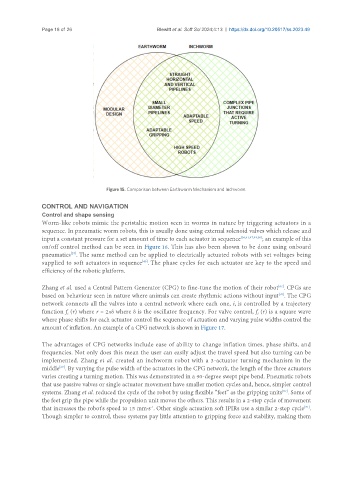
                                     Figure 15. Comparison between Earthworm Mechanism and Inchworm.

               CONTROL AND NAVIGATION
               Control and shape sensing
               Worm-like robots mimic the peristaltic motion seen in worms in nature by triggering actuators in a
               sequence. In pneumatic worm robots, this is usually done using external solenoid valves which release and
               input a constant pressure for a set amount of time to each actuator in sequence [36,41,47,49,50] ; an example of this
               on/off control method can be seen in Figure 16. This has also been shown to be done using onboard
               pneumatics . The same method can be applied to electrically actuated robots with set voltages being
                         [37]
                                                 [46]
               supplied to soft actuators in sequence . The phase cycles for each actuator are key to the speed and
               efficiency of the robotic platform.

                                                                                               [67]
               Zhang et al. used a Central Pattern Generator (CPG) to fine-tune the motion of their robot . CPGs are
                                                                                               [70]
               based on behaviour seen in nature where animals can create rhythmic actions without input . The CPG
               network connects all the valves into a central network where each one, i, is controlled by a trajectory
               function f (r) where r = 2πδ where δ is the oscillator frequency. For valve control, f (r) is a square wave
                        i
                                                                                        i
               where phase shifts for each actuator control the sequence of actuation and varying pulse widths control the
               amount of inflation. An example of a CPG network is shown in Figure 17.

               The advantages of CPG networks include ease of ability to change inflation times, phase shifts, and
               frequencies. Not only does this mean the user can easily adjust the travel speed but also turning can be
               implemented. Zhang et al. created an inchworm robot with a 3-actuator turning mechanism in the
               middle . By varying the pulse width of the actuators in the CPG network, the length of the three actuators
                     [67]
               varies creating a turning motion. This was demonstrated in a 90-degree swept pipe bend. Pneumatic robots
               that use passive valves or single actuator movement have smaller motion cycles and, hence, simpler control
                                                                                                [67]
               systems. Zhang et al. reduced the cycle of the robot by using flexible “feet” as the gripping units . Some of
               the feet grip the pipe while the propulsion unit moves the others. This results in a 2-step cycle of movement
                                                                                                        [71]
                                                    -1
               that increases the robot's speed to 15 mm·s . Other single actuation soft IPIRs use a similar 2-step cycle .
               Though simpler to control, these systems pay little attention to gripping force and stability, making them

