


Page 29 - Read Online
P. 29
Blewitt et al. Soft Sci 2024;4:13  https://dx.doi.org/10.20517/ss.2023.49       Page 11 of 26


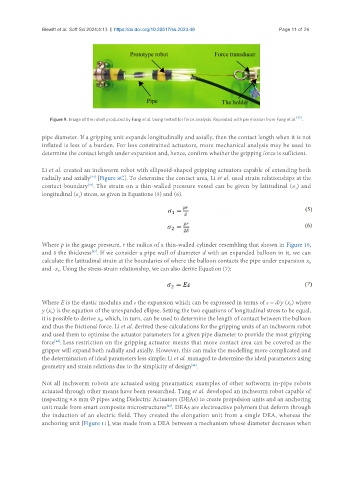
                  Figure 9. Image of the robot produced by Fang et al. being tested for force analysis. Reprinted with permission from Fang et al. [43] .

               pipe diameter. If a gripping unit expands longitudinally and axially, then the contact length when it is not
               inflated is less of a burden. For less constrained actuators, more mechanical analysis may be used to
               determine the contact length under expansion and, hence, confirm whether the gripping force is sufficient.


               Li et al. created an inchworm robot with ellipsoid-shaped gripping actuators capable of extending both
               radially and axially  [Figure 8C]. To determine the contact area, Li et al. used strain relationships at the
                               [44]
                               [44]
               contact boundary . The strain on a thin-walled pressure vessel can be given by latitudinal (σ ) and
                                                                                                     1
               longitudinal (σ ) stress, as given in Equations (5) and (6).
                           2


               Where p is the gauge pressure, r the radius of a thin-walled cylinder resembling that shown in Figure 10,
               and δ the thickness . If we consider a pipe wall of diameter d with an expanded balloon in it, we can
                                [45]
               calculate the latitudinal strain at the boundaries of where the balloon contacts the pipe under expansion x
                                                                                                         b
               and -x . Using the stress-strain relationship, we can also derive Equation (7):
                     b


               Where E is the elastic modulus and ε the expansion which can be expressed in terms of ε = d/y (x ) where
                                                                                                   b
               y (x ) is the equation of the unexpanded ellipse. Setting the two equations of longitudinal stress to be equal,
                  b
               it is possible to derive x , which, in turn, can be used to determine the length of contact between the balloon
                                   b
               and thus the frictional force. Li et al. derived these calculations for the gripping units of an inchworm robot
               and used them to optimise the actuator parameters for a given pipe diameter to provide the most gripping
               force . Less restriction on the gripping actuator means that more contact area can be covered as the
                   [44]
               gripper will expand both radially and axially. However, this can make the modelling more complicated and
               the determination of ideal parameters less simple; Li et al. managed to determine the ideal parameters using
                                                                 [44]
               geometry and strain relations due to the simplicity of design .

               Not all inchworm robots are actuated using pneumatics; examples of other softworm in-pipe robots
               actuated through other means have been researched. Tang et al. developed an inchworm robot capable of
               inspecting 9.8 mm Ø pipes using Dielectric Actuators (DEAs) to create propulsion units and an anchoring
               unit made from smart composite microstructures . DEAs are electroactive polymers that deform through
                                                         [46]
               the induction of an electric field. They created the elongation unit from a single DEA, whereas the
               anchoring unit [Figure 11], was made from a DEA between a mechanism whose diameter decreases when

