


Page 24 - Read Online
P. 24
Page 6 of 26                           Blewitt et al. Soft Sci 2024;4:13  https://dx.doi.org/10.20517/ss.2023.49


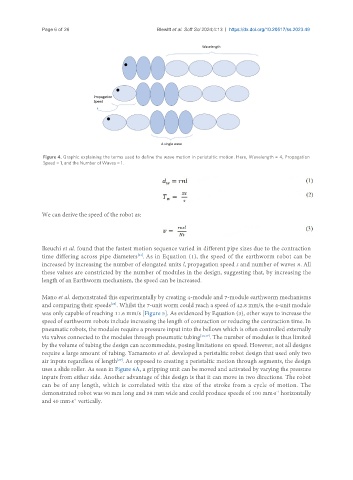
                Figure 4. Graphic explaining the terms used to define the wave motion in peristaltic motion. Here, Wavelength = 4, Propagation
                Speed = 1, and the Number of Waves = 1.


               We can derive the speed of the robot as:


               Ikeuchi et al. found that the fastest motion sequence varied in different pipe sizes due to the contraction
                                               [21]
               time differing across pipe diameters . As in Equation (1), the speed of the earthworm robot can be
               increased by increasing the number of elongated units l, propagation speed s and number of waves n. All
               these values are constricted by the number of modules in the design, suggesting that, by increasing the
               length of an Earthworm mechanism, the speed can be increased.


               Mano et al. demonstrated this experimentally by creating 4-module and 7-module earthworm mechanisms
               and comparing their speeds . Whilst the 7-unit worm could reach a speed of 42.8 mm/s, the 4-unit module
                                      [28]
               was only capable of reaching 11.6 mm/s [Figure 5]. As evidenced by Equation (3), other ways to increase the
               speed of earthworm robots include increasing the length of contraction or reducing the contraction time. In
               pneumatic robots, the modules require a pressure input into the bellows which is often controlled externally
               via valves connected to the modules through pneumatic tubing [13,17] . The number of modules is thus limited
               by the volume of tubing the design can accommodate, posing limitations on speed. However, not all designs
               require a large amount of tubing. Yamamoto et al. developed a peristaltic robot design that used only two
               air inputs regardless of length . As opposed to creating a peristaltic motion through segments, the design
                                         [29]
               uses a slide roller. As seen in Figure 6A, a gripping unit can be moved and activated by varying the pressure
               inputs from either side. Another advantage of this design is that it can move in two directions. The robot
               can be of any length, which is correlated with the size of the stroke from a cycle of motion. The
               demonstrated robot was 90 mm long and 38 mm wide and could produce speeds of 100 mm·s  horizontally
                                                                                              -1
               and 40 mm·s  vertically.
                          -1

