


Page 21 - Read Online
P. 21
Blewitt et al. Soft Sci 2024;4:13  https://dx.doi.org/10.20517/ss.2023.49        Page 3 of 26


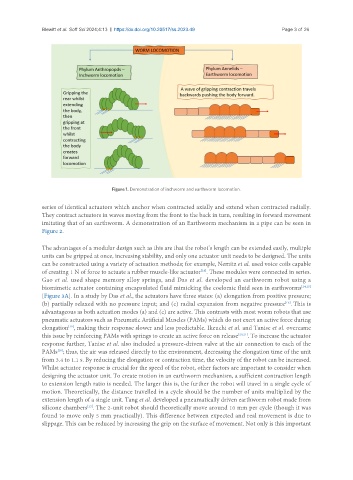
                                       Figure 1. Demonstration of inchworm and earthworm locomotion.


               series of identical actuators which anchor when contracted axially and extend when contracted radially.
               They contract actuators in waves moving from the front to the back in turn, resulting in forward movement
               imitating that of an earthworm. A demonstration of an Earthworm mechanism in a pipe can be seen in
               Figure 2.

               The advantages of a modular design such as this are that the robot’s length can be extended easily, multiple
               units can be gripped at once, increasing stability, and only one actuator unit needs to be designed. The units
               can be constructed using a variety of actuation methods; for example, Nemitz et al. used voice coils capable
               of creating 1 N of force to actuate a rubber muscle-like actuator . These modules were connected in series.
                                                                     [18]
               Gao et al. used shape memory alloy springs, and Das et al. developed an earthworm robot using a
               biomimetic actuator containing encapsulated fluid mimicking the coelomic fluid seen in earthworms [14,15]
               [Figure 3A]. In a study by Das et al., the actuators have three states: (a) elongation from positive pressure;
               (b) partially relaxed with no pressure input; and (c) radial expansion from negative pressure . This is
                                                                                                 [15]
               advantageous as both actuation modes (a) and (c) are active. This contrasts with most worm robots that use
               pneumatic actuators such as Pneumatic Artificial Muscles (PAMs) which do not exert an active force during
               elongation , making their response slower and less predictable. Ikeuchi et al. and Tanise et al. overcame
                        [19]
               this issue by reinforcing PAMs with springs to create an active force on release [20,21] . To increase the actuator
               response further, Tanise et al. also included a pressure-driven valve at the air connection to each of the
               PAMs ; thus, the air was released directly to the environment, decreasing the elongation time of the unit
                    [20]
               from 3.4 to 1.1 s. By reducing the elongation or contraction time, the velocity of the robot can be increased.
               Whilst actuator response is crucial for the speed of the robot, other factors are important to consider when
               designing the actuator unit. To create motion in an earthworm mechanism, a sufficient contraction length
               to extension length ratio is needed. The larger this is, the further the robot will travel in a single cycle of
               motion. Theoretically, the distance travelled in a cycle should be the number of units multiplied by the
               extension length of a single unit. Tang et al. developed a pneumatically driven earthworm robot made from
                              [13]
               silicone chambers . The 2-unit robot should theoretically move around 10 mm per cycle (though it was
               found to move only 5 mm practically). This difference between expected and real movement is due to
               slippage. This can be reduced by increasing the grip on the surface of movement. Not only is this important

