


Page 20 - Read Online
P. 20
Jan et al. Soft Sci 2024;4:10  https://dx.doi.org/10.20517/ss.2023.54            Page 9 of 12


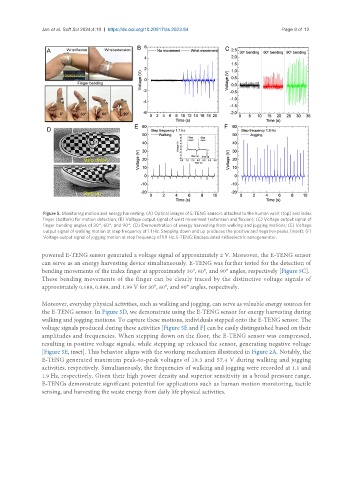
                Figure 5. Monitoring motion and energy harvesting. (A) Optical images of E-TENG sensors attached to the human wrist (top) and index
                finger (bottom) for motion detection; (B) Voltage output signal of wrist movement (extension and flexion); (C) Voltage output signal of
                finger bending angles of 30°, 60°, and 90°; (D) Demonstration of energy harvesting from walking and jogging motions; (E) Voltage
                output signal of walking motion at step frequency of 1.1 Hz. Stepping down and up produces the positive and negative peaks (inset); (F)
                Voltage output signal of jogging motion at step frequency of 1.9 Hz. E-TENG: Encapsulated-triboelectric nanogenerator.

               powered E-TENG sensor generated a voltage signal of approximately 2 V. Moreover, the E-TENG sensor
               can serve as an energy harvesting device simultaneously. E-TENG was further tested for the detection of
               bending movements of the index finger at approximately 30°, 60°, and 90° angles, respectively [Figure 5C].
               These bending movements of the finger can be clearly traced by the distinctive voltage signals of
               approximately 0.188, 0.889, and 1.99 V for 30°, 60°, and 90° angles, respectively.

               Moreover, everyday physical activities, such as walking and jogging, can serve as valuable energy sources for
               the E-TENG sensor. In Figure 5D, we demonstrate using the E-TENG sensor for energy harvesting during
               walking and jogging motions. To capture these motions, individuals stepped onto the E-TENG sensor. The
               voltage signals produced during these activities [Figure 5E and F] can be easily distinguished based on their
               amplitudes and frequencies. When stepping down on the floor, the E-TENG sensor was compressed,
               resulting in positive voltage signals, while stepping up released the sensor, generating negative voltage
               [Figure 5E, inset]. This behavior aligns with the working mechanism illustrated in Figure 2A. Notably, the
               E-TENG generated maximum peak-to-peak voltages of 18.3 and 57.4 V during walking and jogging
               activities, respectively. Simultaneously, the frequencies of walking and jogging were recorded at 1.1 and
               1.9 Hz, respectively. Given their high power density and superior sensitivity in a broad pressure range,
               E-TENGs demonstrate significant potential for applications such as human motion monitoring, tactile
               sensing, and harvesting the waste energy from daily life physical activities.

