


Page 22 - Read Online
P. 22
Page 16 of 25             Singh et al. Mini-invasive Surg. 2025;9:28  https://dx.doi.org/10.20517/2574-1225.2024.75


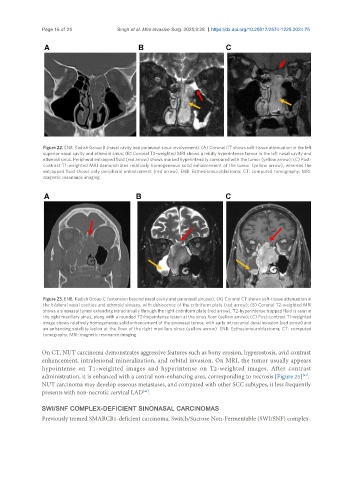
                Figure 22. ENB, Kadish Group B (nasal cavity and paranasal sinus involvement). (A) Coronal CT shows soft-tissue attenuation in the left
                superior nasal cavity and ethmoid sinus; (B) Coronal T2-weighted MRI shows a mildly hyperintense tumor in the left nasal cavity and
                ethmoid sinus. Peripheral entrapped fluid (red arrow) shows marked hyperintensity compared with the tumor (yellow arrow); (C) Post-
                contrast T1-weighted MRI demonstrates relatively homogeneous solid enhancement of the tumor (yellow arrow), whereas the
                entrapped fluid shows only peripheral enhancement (red arrow). ENB: Esthesioneuroblastoma; CT: computed tomography; MRI:
                magnetic resonance imaging.


                Figure 23. ENB, Kadish Group C (extension beyond nasal cavity and paranasal sinuses). (A) Coronal CT shows soft-tissue attenuation in
                the bilateral nasal cavities and ethmoid sinuses, with dehiscence of the cribriform plate (red arrow); (B) Coronal T2-weighted MRI
                shows a sinonasal tumor extending intracranially through the right cribriform plate (red arrow). T2-hyperintense trapped fluid is seen in
                the right maxillary sinus, along with a rounded T2-hypointense lesion at the sinus floor (yellow arrow); (C) Post-contrast T1-weighted
                image shows relatively homogeneous solid enhancement of the sinonasal tumor, with early intracranial dural invasion (red arrow) and
                an enhancing satellite lesion at the floor of the right maxillary sinus (yellow arrow). ENB: Esthesioneuroblastoma; CT: computed
                tomography; MRI: magnetic resonance imaging.

               On CT, NUT carcinoma demonstrates aggressive features such as bony erosion, hyperostosis, avid contrast
               enhancement, intralesional mineralization, and orbital invasion. On MRI, the tumor usually appears
               hypointense  on  T1-weighted  images  and  hyperintense  on  T2-weighted  images.  After  contrast
                                                                                                       [41]
               administration, it is enhanced with a central non-enhancing area, corresponding to necrosis [Figure 25] .
               NUT carcinoma may develop osseous metastases, and compared with other SCC subtypes, it less frequently
               presents with non-necrotic cervical LAD .
                                                 [41]

               SWI/SNF COMPLEX-DEFICIENT SINONASAL CARCINOMAS
               Previously termed SMARCB1-deficient carcinoma, Switch/Sucrose Non-Fermentable (SWI/SNF) complex-

