


Page 16 - Read Online
P. 16
Page 10 of 25             Singh et al. Mini-invasive Surg. 2025;9:28  https://dx.doi.org/10.20517/2574-1225.2024.75


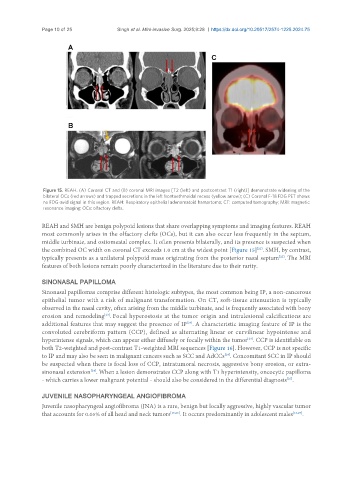
                Figure 15. REAH. (A) Coronal CT and (B) coronal MRI images [T2 (left) and postcontrast T1 (right)] demonstrate widening of the
                bilateral OCs (red arrows) and trapped secretions in the left frontoethmoidal recess (yellow arrow); (C) Coronal F-18 FDG PET shows
                no FDG-avid signal in this region. REAH: Respiratory epithelial adenomatoid hamartoma; CT: computed tomography; MRI: magnetic
                resonance imaging; OCs: olfactory clefts.


               REAH and SMH are benign polypoid lesions that share overlapping symptoms and imaging features. REAH
               most commonly arises in the olfactory clefts (OCs), but it can also occur less frequently in the septum,
               middle turbinate, and ostiomeatal complex. It often presents bilaterally, and its presence is suspected when
               the combined OC width on coronal CT exceeds 1.0 cm at the widest point [Figure 15] . SMH, by contrast,
                                                                                        [21]
                                                                                               [22]
               typically presents as a unilateral polypoid mass originating from the posterior nasal septum . The MRI
               features of both lesions remain poorly characterized in the literature due to their rarity.

               SINONASAL PAPILLOMA
               Sinonasal papillomas comprise different histologic subtypes, the most common being IP, a non-cancerous
               epithelial tumor with a risk of malignant transformation. On CT, soft-tissue attenuation is typically
               observed in the nasal cavity, often arising from the middle turbinate, and is frequently associated with bony
               erosion and remodeling . Focal hyperostosis at the tumor origin and intralesional calcifications are
                                    [23]
                                                                [23]
               additional features that may suggest the presence of IP . A characteristic imaging feature of IP is the
               convoluted cerebriform pattern (CCP), defined as alternating linear or curvilinear hypointense and
               hyperintense signals, which can appear either diffusely or focally within the tumor . CCP is identifiable on
                                                                                    [24]
               both T2-weighted and post-contrast T1-weighted MRI sequences [Figure 16]. However, CCP is not specific
                                                                             [24]
               to IP and may also be seen in malignant cancers such as SCC and AdCCs . Concomitant SCC in IP should
               be suspected when there is focal loss of CCP, intratumoral necrosis, aggressive bony erosion, or extra-
               sinonasal extension . When a lesion demonstrates CCP along with T1 hyperintensity, oncocytic papilloma
                                [24]
               - which carries a lower malignant potential - should also be considered in the differential diagnosis .
                                                                                                  [25]
               JUVENILE NASOPHARYNGEAL ANGIOFIBROMA
               Juvenile nasopharyngeal angiofibroma (JNA) is a rare, benign but locally aggressive, highly vascular tumor
               that accounts for 0.05% of all head and neck tumors [16,26] . It occurs predominantly in adolescent males [16,27] .

