


Page 149 - Read Online
P. 149
Page 10 of 17                                                    Zhang et al. J. Mater. Inf. 2026, 6, 11


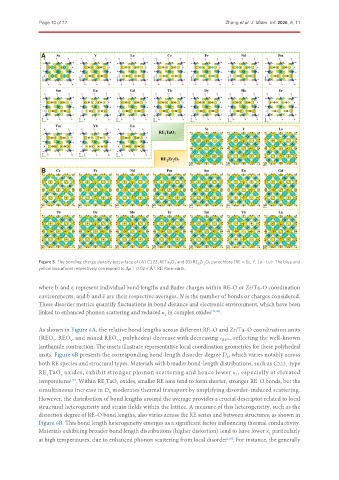
               Figure 5. The bonding charge density isosurface of (A) C222 1  RETa 3 O 7  and (B) RE 2 Zr 2 O 7  pyrochlore (RE = Sc, Y, La ~ Lu). The blue and
               yellow isosurfaces respectively correspond to Δρ ± 0.02 e Å . RE: Rare-earth.
                                                     -
                                                       -3
               where b and e represent individual bond lengths and Bader charges within RE–O or Zr/Ta–O coordination
                     i
                           i
               environments, and b and e are their respective averages. N is the number of bonds or charges considered.
                                ¯
                                     ¯
               These disorder metrics quantify fluctuations in bond distance and electronic environment, which have been
               linked to enhanced phonon scattering and reduced κ  in complex oxides [14,30] .
                                                           L
               As shown in Figure 6A, the relative bond lengths across different RE–O and Zr/Ta–O coordination units
               (REO , REO , and mixed REO  polyhedra) decrease with decreasing r RE3+ , reflecting the well-known
                    7
                                          7/8
                          8
               lanthanide contraction. The insets illustrate representative local coordination geometries for these polyhedral
               units. Figure 6B presents the corresponding bond-length disorder degree D , which varies notably across
                                                                                 b
               both RE species and structural types. Materials with broader bond-length distributions, such as C222 -type
                                                                                                     1
               RE TaO  oxides, exhibit stronger phonon scattering and hence lower κ , especially at elevated
                                                                                    L
                 3
                      7
               temperatures . Within RE TaO  oxides, smaller RE ions tend to form shorter, stronger RE–O bonds, but the
                          [18]
                                          7
                                      3
               simultaneous increase in D  moderates thermal transport by amplifying disorder-induced scattering.
                                       b
               However, the distribution of bond lengths around the average provides a crucial descriptor related to local
               structural heterogeneity and strain fields within the lattice. A measure of this heterogeneity, such as the
               distortion degree of RE–O bond lengths, also varies across the RE series and between structures, as shown in
               Figure 6B. This bond length heterogeneity emerges as a significant factor influencing thermal conductivity.
               Materials exhibiting broader bond length distributions (higher distortion) tend to have lower κ  particularly
                                                                                               L
               at high temperatures, due to enhanced phonon scattering from local disorder . For instance, the generally
                                                                                 [18]

