


Page 147 - Read Online
P. 147
Page 8 of 17                                                     Zhang et al. J. Mater. Inf. 2026, 6, 11


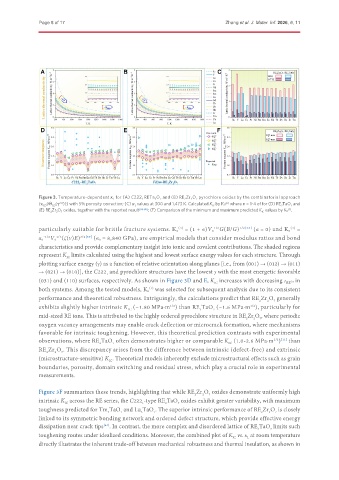
               Figure 3. Temperature-dependent κ L  for (A) C222 1  RETa 3 O 7  and (B) RE 2 Zr 2 O 7  pyrochlore oxides by the combinatorial approach
               (κ (2) (Θ (2) (γ ))) with 5% porosity correction; (C) κ L  values at 300 and 1,473 K. Calculated K IC  by K0  where n = 1-4 of for (D) RE 3 TaO 7  and
                                                                                (n)
                      (3)
               (E) RE 2 Zr 2 O 7  oxides, together with the reported result [69-80] ; (F) Comparison of the minimum and maximum predicted K IC  values by K0 .
                                                                                                      (1)
               particularly suitable for brittle fracture systems. K 0  = (1 + α)V 0 G(B/G) 1/2[58]  (α = 0) and K 0  =
                                                                (3)
                                                                                                       (4)
                                                                            1/6
               α 0 V 0 (ζ(v)E) 3/2[59]  (α 0 = 8,840 GPa), are empirical models that consider modulus ratios and bond
                -1/2
                     1/6
               characteristics and provide complementary insight into ionic and covalent contributions. The shaded regions
               represent K  limits calculated using the highest and lowest surface energy values for each structure. Through
                        IC
               plotting surface energy (γ) as a function of relative orientation along planes [i.e., from (001) → (012) → (011)
               → (021) → (010)], the C222  and pyrochlore structures have the lowest γ with the most energetic favorable
                                      1
               (031) and (110) surfaces, respectively. As shown in Figure 3D and E, K  increases with decreasing r RE3+  in
                                                                            IC
               both systems. Among the tested models, K 0  was selected for subsequent analysis due to its consistent
                                                     (1)
               performance and theoretical robustness. Intriguingly, the calculations predict that RE Zr O  generally
                                                                                            2
                                                                                               2
                                                                                                 7
               exhibits slightly higher intrinsic K  (~1.80 MPa·m ) than RE TaO  (~1.6 MPa·m ), particularly for
                                                             1/2
                                                                                         1/2
                                                                            7
                                              IC
                                                                       3
               mid-sized RE ions. This is attributed to the highly ordered pyrochlore structure in RE Zr O , where periodic
                                                                                            7
                                                                                       2
                                                                                          2
               oxygen vacancy arrangements may enable crack deflection or microcrack formation, where mechanisms
               favorable for intrinsic toughening. However, this theoretical prediction contrasts with experimental
               observations, where RE TaO  often demonstrates higher or comparable K  (1.0-2.6 MPa·m )  than
                                                                                                 1/2 [11]
                                                                                 IC
                                         7
                                    3
               RE Zr O . This discrepancy arises from the difference between intrinsic (defect-free) and extrinsic
                       7
                    2
                 2
               (microstructure-sensitive) K . Theoretical models inherently exclude microstructural effects such as grain
                                       IC
               boundaries, porosity, domain switching and residual stress, which play a crucial role in experimental
               measurements.
               Figure 3F summarizes these trends, highlighting that while RE Zr O  oxides demonstrate uniformly high
                                                                        2
                                                                          7
                                                                     2
               intrinsic K  across the RE series, the C222 -type RE TaO  oxides exhibit greater variability, with maximum
                                                           3
                                                   1
                        IC
                                                               7
               toughness predicted for Tm TaO  and Lu TaO . The superior intrinsic performance of RE Zr O  is closely
                                                                                               2
                                                                                             2
                                           7
                                       3
                                                       7
                                                   3
                                                                                                  7
               linked to its symmetric bonding network and ordered defect structure, which provide effective energy
               dissipation near crack tips . In contrast, the more complex and disordered lattice of RE TaO  limits such
                                     [64]
                                                                                                7
                                                                                           3
               toughening routes under idealized conditions. Moreover, the combined plot of K  vs. κ  at room temperature
                                                                                        L
                                                                                   IC
               directly illustrates the inherent trade-off between mechanical robustness and thermal insulation, as shown in

