


Page 144 - Read Online
P. 144
Zhang et al. J. Mater. Inf. 2026, 6, 11                                           Page 5 of 17


               First-principles calculations
               All DFT calculations were carried out using the projector augmented wave (PAW) method with the
               Perdew–Burke–Ernzerhof (PBE) exchange–correlation functional within the generalized gradient
               approximation (GGA) as implemented in the Vienna Ab initio Simulation Package (VASP) . Spin
                                                                                                   [46]
               polarization was enabled, and the plane-wave energy cutoff was set to 1.4 times the maximum elemental
               ENMAX, where ENMAX denotes the recommended kinetic energy cutoff specified in the VASP
               pseudopotential files. k-point meshes of 4 × 4 × 4 ensured convergence of total energy within 10  eV·atom .
                                                                                                         -1
                                                                                                -6
               Although applying Hubbard U corrections may improve prediction accuracy, the primary focus of this work
               is on trend-level comparisons across a wide compositional space. Several studies have established the
               effectiveness of GGA functionals in describing the properties of RE compounds [47-49] . Therefore, omitting U
               corrections introduces negligible error in the context of structural, elastic, and thermodynamic analysis.
               Moreover, this choice avoids the element-specific arbitrariness associated with U parameter selection and
               ensures methodological consistency throughout the high-throughput workflow . Accordingly, all
                                                                                        [49]
               calculations in this study were carried out using the PBE functional within the GGA framework without +U
               corrections , providing a robust and computationally efficient platform for capturing structure–property
                        [50]
               relationships in RE zirconates and tantalates. The V 0 and equilibrium energy (E 0) were obtained by fitting the
               total energy–volume data to the four-parameter Birch-Murnaghan equation of state . Elastic constants were
                                                                                     [51]
               obtained using the energy–strain method, from which mechanical properties including bulk modulus, shear
               modulus, Young’s modulus, and Poisson’s ratio were derived via the Voigt–Reuss–Hill averaging scheme [52,53] .


               Lattice thermal conductivity
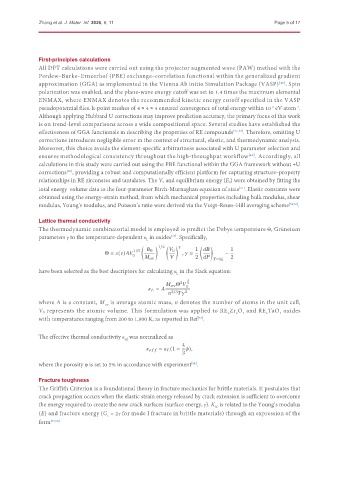
               The thermodynamic combinatorial model is employed to predict the Debye temperature Θ, Grüneisen
               parameters γ to the temperature-dependent κ  in oxides . Specifically,
                                                             [27]
                                                    L
                                                   (    ) 1/2  (  )     1       )  1
                                                                       (
                                      Θ =   (  )     1/6     0     0  ,    =    −
                                                0
                                                                      2         =0    2
               have been selected as the best descriptors for calculating κ  in the Slack equation:
                                                               L
                                                                   1
                                                                3
                                                                   Θ     3
                                                           =      0
                                                               2/3      2
               where A is a constant, M  is average atomic mass, n denotes the number of atoms in the unit cell,
                                      av
               V 0 represents the atomic volume. This formulation was applied to RE Zr O  and RE TaO  oxides
                                                                                              3
                                                                                 2
                                                                                    2
                                                                                      7
                                                                                                   7
               with temperatures ranging from 200 to 1,800 K, as reported in Ref .
                                                                      [27]
               The effective thermal conductivity κ  was normalized as
                                             eff
                                                                 4
                                                                =       (1 −   ),
                                                                 3
               where the porosity j is set to 5% in accordance with experiment .
                                                                    [54]
               Fracture toughness
               The Griffith Criterion is a foundational theory in fracture mechanics for brittle materials. It postulates that
               crack propagation occurs when the elastic strain energy released by crack extension is sufficient to overcome
               the energy required to create the new crack surfaces (surface energy, γ). K  is related to the Young’s modulus
                                                                            IC
               (E) and fracture energy (G  = 2γ for mode I fracture in brittle materials) through an expression of the
                                       c
               form [55,56]

