


Page 140 - Read Online
P. 140
Research Article  |  Open Access

                                        Journal of Materials

                                                 Informatics


                                         Zhang et al. J. Mater. Inf. 2026, 6, 11      DOI:10.20517/jmi.2025.71

               A data-driven comparative study of

               thermomechanical properties in rare-earth zirconate
               and tantalate oxides for thermal barrier coatings


               Ying Zhang , William Yi Wang 2,3,* , Ke Ren , Zhou Wang , Xingyu Gao , Yiguang Wang , Keke Zhang ,
                                                                                      4
                                                 4
                                                                                                  1,*
                        1
                                                            1
                                                                        5
               Haifeng Song , Xiubing Liang , Jinshan Li 2,3,*
                          5
                                        2,6
               Keywords:
               Rare-earth oxides, fracture
               toughness, lattice thermal
               conductivity, key physical
               parameter, first-principles
               Citation: Zhang, Y.;
               Wang, W. Y.; Ren, K.;
               Wang, Z.; Gao, X.; Wang, Y.;
               Zhang, K.; Song, H.; Liang, X.;
               Li, J. A data-driven
               comparative study of
               thermomechanical
               properties in rare-earth
               zirconate and tantalate
               oxides for thermal barrier
               coatings. J. Mater. Inf. 2026,
               6, 11.
               https://dx.doi.org/10.20517
               /jmi.2025.71        Abstract
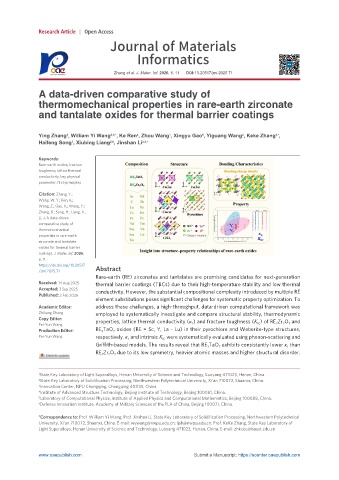
                                   Rare-earth (RE) zirconates and tantalates are promising candidates for next-generation
               Received: 14 Aug 2025  thermal barrier coatings (TBCs) due to their high-temperature stability and low thermal
               Accepted: 3 Sep 2025  conductivity. However, the substantial compositional complexity introduced by multiple RE
               Published: 2 Feb 2026
                                   element substitutions poses significant challenges for systematic property optimization. To
               Academic Editor:    address these challenges, a high-throughput, data-driven computational framework was
               Zhiliang Zhang      employed to systematically investigate and compare structural stability, thermodynamic
               Copy Editor:        properties, lattice thermal conductivity (κ L ) and fracture toughness (K IC ) of RE 2 Zr 2 O 7  and
               Pei-Yun Wang
               Production Editor:  RE 3 TaO 7   oxides  (RE  =  Sc,  Y,  La  ~  Lu)  in  their  pyrochlore  and  Weberite-type  structures,
               Pei-Yun Wang        respectively. κ L  and intrinsic K IC  were systematically evaluated using phonon-scattering and
                                   Griffith-based models. The results reveal that RE 3 TaO 7  exhibits consistently lower κ L  than
                                   RE 2 Zr 2 O 7  due to its low symmetry, heavier atomic masses and higher structural disorder.


               1 State Key Laboratory of Light Superalloys, Henan University of Science and Technology, Luoyang 471023, Henan, China.
               2 State Key Laboratory of Solidification Processing, Northwestern Polytechnical University, Xi’an 710072, Shaanxi, China.
               3 Innovation Center, NPU Chongqing, Chongqing 401135, China.
               4 Institute of Advanced Structure Technology, Beijing Institute of Technology, Beijing 100081, China.
               5 Laboratory of Computational Physics, Institute of Applied Physics and Computational Mathematics, Beijing 100088, China.
               6 Defense Innovation Institute, Academy of Military Sciences of the PLA of China, Beijing 100071, China.

               * Correspondence to: Prof. William Yi Wang, Prof. Jinshan Li, State Key Laboratory of Solidification Processing, Northwestern Polytechnical
               University, Xi’an 710072, Shaanxi, China. E-mail: wywang@nwpu.edu.cn; ljsh@nwpu.edu.cn; Prof. KeKe Zhang, State Key Laboratory of
               Light Superalloys, Henan University of Science and Technology, Luoyang 471023, Henan, China. E-mail: zhkeke@haust.edu.cn


               www.oaepublish.com                                    Submit a Manuscript: https://ucenter.oaepublish.com

