


Page 143 - Read Online
P. 143
Page 4 of 17                                                     Zhang et al. J. Mater. Inf. 2026, 6, 11


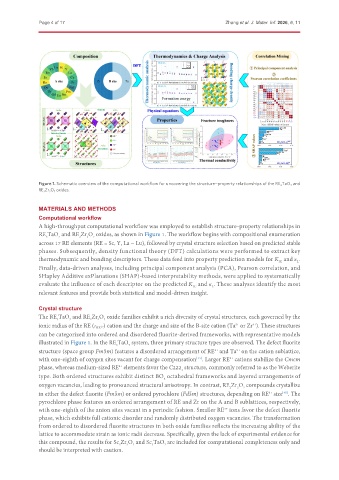
               Figure 1. Schematic overview of the computational workflow for uncovering the structure–property relationships of the RE 3 TaO 7  and
               RE 2 Zr 2 O 7  oxides.


               MATERIALS AND METHODS
               Computational workflow
               A high-throughput computational workflow was employed to establish structure–property relationships in
               RE TaO  and RE Zr O  oxides, as shown in Figure 1. The workflow begins with compositional enumeration
                      7
                               2
                 3
                             2
                                  7
               across 17 RE elements (RE = Sc, Y, La ~ Lu), followed by crystal structure selection based on predicted stable
               phases. Subsequently, density functional theory (DFT) calculations were performed to extract key
               thermodynamic and bonding descriptors. These data feed into property prediction models for K  and κ .
                                                                                                   IC
                                                                                                         L
               Finally, data-driven analyses, including principal component analysis (PCA), Pearson correlation, and
               SHapley Additive exPlanations (SHAP)-based interpretability methods, were applied to systematically
               evaluate the influence of each descriptor on the predicted K  and κ . These analyses identify the most
                                                                           L
                                                                     IC
               relevant features and provide both statistical and model-driven insight.
               Crystal structure
               The RE TaO  and RE Zr O  oxide families exhibit a rich diversity of crystal structures, each governed by the
                     3
                                     7
                                 2
                         7
                                   2
               ionic radius of the RE (r ) cation and the charge and size of the B-site cation (Ta  or Zr ). These structures
                                                                                          4+
                                                                                    5+
                                   RE3+
               can be categorized into ordered and disordered fluorite-derived frameworks, with representative models
               illustrated in Figure 1. In the RE TaO  system, three primary structure types are observed. The defect fluorite
                                              7
                                          3
               structure (space group Fm3m) features a disordered arrangement of RE  and Ta  on the cation sublattice,
                                                                            3+
                                                                                    5+
                                     ¯
               with one-eighth of oxygen sites vacant for charge compensation . Larger RE  cations stabilize the Cmcm
                                                                      [11]
                                                                                  3+
               phase, whereas medium-sized RE  elements favor the C222  structure, commonly referred to as the Weberite
                                           3+
                                                                 1
               type. Both ordered structures exhibit distinct BO  octahedral frameworks and layered arrangements of
                                                           6
               oxygen vacancies, leading to pronounced structural anisotropy. In contrast, RE Zr O  compounds crystallize
                                                                                  2
                                                                                      7
                                                                                    2
               in either the defect fluorite (Fm3m) or ordered pyrochlore (Fd3m) structures, depending on RE  size . The
                                                                                                    [45]
                                                                                               3+
                                         ¯
                                                                   ¯
               pyrochlore phase features an ordered arrangement of RE and Zr on the A and B sublattices, respectively,
               with one-eighth of the anion sites vacant in a periodic fashion. Smaller RE  ions favor the defect fluorite
                                                                                3+
               phase, which exhibits full cationic disorder and randomly distributed oxygen vacancies. The transformation
               from ordered to disordered fluorite structures in both oxide families reflects the increasing ability of the
               lattice to accommodate strain as ionic radii decrease. Specifically, given the lack of experimental evidence for
               this compound, the results for Sc Zr O  and Sc TaO  are included for computational completeness only and
                                             2
                                           2
                                                7
                                                           7
                                                      3
               should be interpreted with caution.

