


Page 145 - Read Online
P. 145
Page 6 of 17                                                     Zhang et al. J. Mater. Inf. 2026, 6, 11


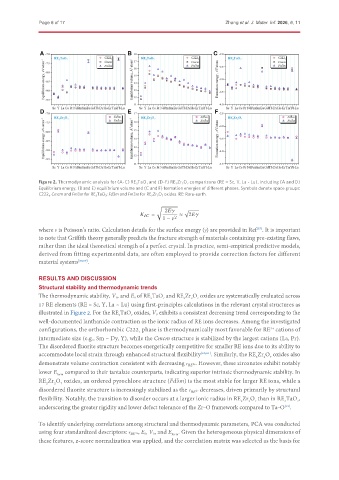
               Figure 2. Thermodynamic analysis for (A-C) RE 3 TaO 7  and (D-F) RE 2 Zr 2 O 7  comparisons (RE = Sc, Y, La ~ Lu), including (A and D)
               Equilibrium energy, (B and E) equilibrium volume and (C and F) formation energies of different phases. Symbols denote space groups:
                            ¯
                                                ¯
                                         ¯
               C222 1 , Cmcm and Fm3m for RE 3 TaO 7 ; Fd3m and Fm3m for RE 2 Zr 2 O 7  oxides. RE: Rare-earth.
                                                        √
                                                           2      √
                                                          =     ≈  2
                                                          1 −    2
               where ν is Poisson’s ratio. Calculation details for the surface energy (γ) are provided in Ref . It is important
                                                                                           [57]
               to note that Griffith theory generally predicts the fracture strength of materials containing pre-existing flaws,
               rather than the ideal theoretical strength of a perfect crystal. In practice, semi-empirical predictive models,
               derived from fitting experimental data, are often employed to provide correction factors for different
               material systems [58,59] .


               RESULTS AND DISCUSSION
               Structural stability and thermodynamic trends
               The thermodynamic stability, V 0, and E 0 of RE TaO  and RE Zr O  oxides are systematically evaluated across
                                                                 2
                                                                    2
                                                                      7
                                                      3
                                                          7
               17 RE elements (RE = Sc, Y, La ~ Lu) using first-principles calculations in the relevant crystal structures as
               illustrated in Figure 2. For the RE TaO  oxides, V 0 exhibits a consistent decreasing trend corresponding to the
                                               7
                                           3
               well-documented lanthanide contraction as the ionic radius of RE ions decreases. Among the investigated
               configurations, the orthorhombic C222  phase is thermodynamically most favorable for RE  cations of
                                                                                                3+
                                                  1
               intermediate size (e.g., Sm ~ Dy, Y), while the Cmcm structure is stabilized by the largest cations (La, Pr).
               The disordered fluorite structure becomes energetically competitive for smaller RE ions due to its ability to
               accommodate local strain through enhanced structural flexibility [60,61] . Similarly, the RE Zr O  oxides also
                                                                                           2
                                                                                              2
                                                                                                7
               demonstrate volume contraction consistent with decreasing r RE3+ . However, these zirconates exhibit notably
               lower E  compared to their tantalate counterparts, indicating superior intrinsic thermodynamic stability. In
                     form
               RE Zr O  oxides, an ordered pyrochlore structure (Fd3m) is the most stable for larger RE ions, while a
                                                               ¯
                    2
                 2
                      7
               disordered fluorite structure is increasingly stabilized as the r RE3+  decreases, driven primarily by structural
               flexibility. Notably, the transition to disorder occurs at a larger ionic radius in RE Zr O  than in RE TaO ,
                                                                                           7
                                                                                                         7
                                                                                                     3
                                                                                      2
                                                                                        2
               underscoring the greater rigidity and lower defect tolerance of the Zr–O framework compared to Ta–O .
                                                                                                     [19]
               To identify underlying correlations among structural and thermodynamic parameters, PCA was conducted
               using four standardized descriptors: r RE3+ , E 0, V 0, and E . Given the heterogeneous physical dimensions of
                                                             form
               these features, z-score normalization was applied, and the correlation matrix was selected as the basis for

