


Page 150 - Read Online
P. 150
Zhang et al. J. Mater. Inf. 2026, 6, 11                                           Page 11 of 17


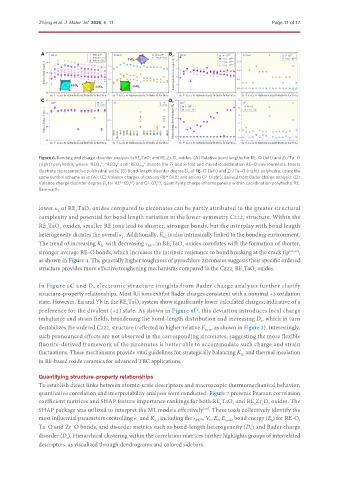
               Figure 6. Bonding and charge disorder analysis in RE 3 TaO 7  and RE 2 Zr 2 O 7  oxides. (A) Relative bond lengths for RE–O (left) and Zr/Ta–O
               (right) polyhedra, where “REO 7 ”, “REO 8 ” and “REO 7/8 ” denote the 7- and 8-fold and mixed-coordination RE–O environments. Insets
               illustrate representative polyhedral units; (B) Bond-length disorder degree D b  of RE–O (left) and Zr/Ta–O (right) polyhedra, using the
               same symbol scheme as in (A); (C) Valence charges of cations RE  (left) and anions O  (right), derived from Bader charge analysis; (D)
                                                                         2-
                                                           3+
               Valence charge disorder degree D e  for RE  (D e ) and O  (D e ), quantifying charge inhomogeneity within coordination polyhedra. RE:
                                                     2-
                                                        O
                                           3+
                                               RE
               Rare-earth.
               lower κ  of RE TaO  oxides compared to zirconates can be partly attributed to the greater structural
                            3
                     L
                                7
               complexity and potential for bond length variation in the lower-symmetry C222  structure. Within the
                                                                                      1
               RE TaO  oxides, smaller RE ions lead to shorter, stronger bonds, but the interplay with bond length
                 3
                      7
               heterogeneity dictates the overall κ . Additionally, K  is also intrinsically linked to the bonding environment.
                                            L
                                                          IC
               The trend of increasing K  with decreasing r  in RE TaO  oxides correlates with the formation of shorter,
                                                             3
                                    IC
                                                     RE3+
                                                                 7
               stronger average RE–O bonds, which increases the intrinsic resistance to bond breaking at the crack tip [66,67] ,
               as shown in Figure 4. The generally higher toughness of pyrochlore zirconates suggests their specific ordered
               structure provides more effective toughening mechanisms compared to the C222  RE TaO  oxides.
                                                                                      3
                                                                                          7
                                                                                   1
               In Figure 6C and D, electronic structure insights from Bader charge analysis further clarify
               structure–property relationships. Most RE ions exhibit Bader charges consistent with a nominal +3 oxidation
               state. However, Eu and Yb in the RE TaO  system show significantly lower calculated charges, indicative of a
                                                  7
                                             3
               preference for the divalent (+2) state. As shown in Figure 6D, this deviation introduces local charge
               imbalance and strain fields, broadening the bond-length distribution and increasing D , which in turn
                                                                                             e
               destabilizes the ordered C222  structure (reflected in higher relative E , as shown in Figure 2). Interestingly,
                                                                         form
                                       1
               such pronounced effects are not observed in the corresponding zirconates, suggesting the more flexible
               fluorite-derived framework of the zirconates is better able to accommodate such charge and strain
               fluctuations. These mechanisms provide vital guidelines for strategically balancing K  and thermal insulation
                                                                                      IC
               in RE-based oxide ceramics for advanced TBC applications.
               Quantifying structure–property relationships
               To establish direct links between atomic-scale descriptors and macroscopic thermomechanical behavior,
               quantitative correlation and interpretability analyses were conducted. Figure 7 presents Pearson correlation
               coefficient matrices and SHAP feature importance rankings for both RE TaO  and RE Zr O  oxides. The
                                                                              3
                                                                                   7
                                                                                             2
                                                                                               7
                                                                                          2
               SHAP package was utilized to interpret the ML models effectively . These tools collectively identify the
                                                                        [68]
               most influential parameters controlling κ  and K , including the r , V 0, E 0, E , bond energy (E ) for RE–O,
                                                                                                b
                                                 L
                                                       IC
                                                                      RE3+
                                                                                form
               Ta–O and Zr–O bonds, and disorder metrics such as bond-length heterogeneity (D ) and Bader charge
                                                                                         b
               disorder (D ). Hierarchical clustering within the correlation matrices further highlights groups of interrelated
                        e
               descriptors, as visualized through dendrograms and colored sidebars.

