


Page 151 - Read Online
P. 151
Page 12 of 17                                                    Zhang et al. J. Mater. Inf. 2026, 6, 11


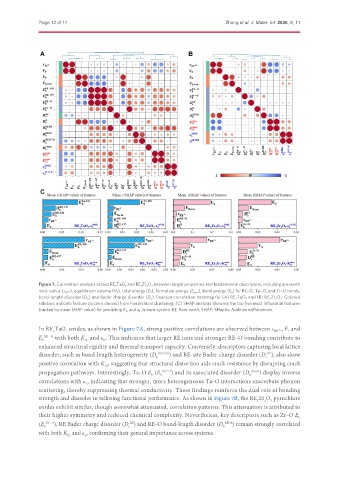
               Figure 7. Correlation analysis across RE 3 TaO 7  and RE 2 Zr 2 O 7  between target properties and fundamental descriptors, including are-earth
               ionic radius (r RE3+ ), equilibrium volume (V0), total energy (E0), formation energy (E form ), bond energy (E b ) for RE–O, Ta–O, and Zr–O bonds,
               bond-length disorder (D b ) and Bader charge disorder (D e ). Pearson correlation heatmap for (A) RE 3 TaO 7  and (B) RE 2 Zr 2 O 7 . Colored
               sidebars indicate feature clusters derived from hierarchical clustering; (C) SHAP analysis showing the top five most influential features
               (ranked by mean SHAP value) for predicting K IC  and κ L  in each system. RE: Rare-earth; SHAP: SHapley Additive exPlanations.


               In RE TaO  oxides, as shown in Figure 7A, strong positive correlations are observed between r RE3+ , E 0 and
                    3
                        7
               E b RE–O  with both K  and κ . This indicates that larger RE ions and stronger RE–O bonding contribute to
                               IC
                                     L
               enhanced structural rigidity and thermal transport capacity. Conversely, descriptors capturing local lattice
               disorder, such as bond-length heterogeneity (D b REO7/8 ) and RE-site Bader charge disorder (D ), also show
                                                                                               RE
                                                                                              e
               positive correlation with K , suggesting that structural distortion aids crack resistance by disrupting crack
                                      IC
               propagation pathways. Interestingly, Ta–O E  (E b Ta–O ) and its associated disorder (D b TaO6 ) display inverse
                                                      b
               correlations with κ , indicating that stronger, more heterogeneous Ta–O interactions exacerbate phonon
                               L
               scattering, thereby suppressing thermal conductivity. These findings reinforce the dual role of bonding
               strength and disorder in tailoring functional performance. As shown in Figure 7B, the RE Zr O  pyrochlore
                                                                                              2
                                                                                                7
                                                                                           2
               oxides exhibit similar, though somewhat attenuated, correlation patterns. This attenuation is attributed to
               their higher symmetry and reduced chemical complexity. Nevertheless, key descriptors such as Zr–O E b
               (E b Zr–O ), RE Bader charge disorder (D ) and RE–O bond-length disorder (D b REO8 ) remain strongly correlated
                                               RE
                                              e
               with both K  and κ , confirming their general importance across systems.
                         IC
                               L

