


Page 83 - Read Online
P. 83
Page 18 of 28           Choi et al. Energy Mater. 2025, 5, 500106  https://dx.doi.org/10.20517/energymater.2025.50


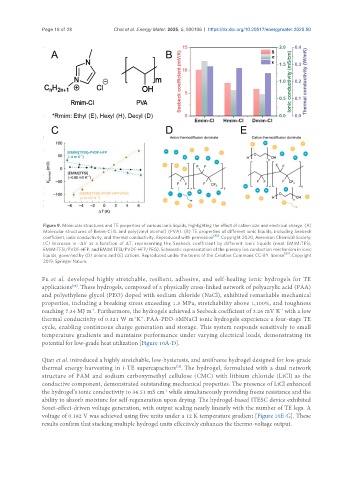
                Figure 9. Molecular structures and TE properties of various ionic liquids, highlighting the effect of cation size and electrical charge. (A)
                Molecular structures of Rmim-Cl IL and poly(vinyl alcohol) (PVA). (B) TE properties of different ionic liquids, including Seebeck
                coefficient, ionic conductivity, and thermal conductivity. Reproduced with permission [80] . Copyright 2020, American Chemical Society;
                (C)  Increase  in  -ΔV  as  a  function  of  ΔT,  representing  the  Seebeck  coefficient  by  different  ionic  liquids  (neat  EMIM:TFSI,
                EMIM:TFSI/PVDF-HFP, and EMIM:TFSI/PVDF-HFP/PEG). Schematic representation of the primary ion conduction mechanism in ionic
                                                                                                 [87]
                liquids, governed by (D) anions and (E) cations. Reproduced under the terms of the Creative Commons CC-BY  license  . Copyright
                2019, Springer Nature.

               Fu et al. developed highly stretchable, resilient, adhesive, and self-healing ionic hydrogels for TE
               applications . These hydrogels, composed of a physically cross-linked network of polyacrylic acid (PAA)
                         [88]
               and polyethylene glycol (PEO) doped with sodium chloride (NaCl), exhibited remarkable mechanical
               properties, including a breaking stress exceeding 1.3 MPa, stretchability above 1,100%, and toughness
                                                                                               -1
                                -3
               reaching 7.34 MJ m . Furthermore, the hydrogels achieved a Seebeck coefficient of 3.26 mV K  with a low
               thermal conductivity of 0.321 W m K . PAA-PEO-3MNaCl ionic hydrogels experience a four-stage TE
                                              -1
                                                -1
               cycle, enabling continuous charge generation and storage. This system responds sensitively to small
               temperature gradients and maintains performance under varying electrical loads, demonstrating its
               potential for low-grade heat utilization [Figure 10A-D].
               Qian et al. introduced a highly stretchable, low-hysteresis, and antifreeze hydrogel designed for low-grade
                                                            [35]
               thermal energy harvesting in i-TE supercapacitors . The hydrogel, formulated with a dual network
               structure of PAM and sodium carboxymethyl cellulose (CMC) with lithium chloride (LiCl) as the
               conductive component, demonstrated outstanding mechanical properties. The presence of LiCl enhanced
               the hydrogel’s ionic conductivity to 36.51 mS cm  while simultaneously providing freeze resistance and the
                                                         -1
               ability to absorb moisture for self-regeneration upon drying. The hydrogel-based ITESC device exhibited
               Soret-effect-driven voltage generation, with output scaling nearly linearly with the number of TE legs. A
               voltage of 0.182 V was achieved using five units under a 12 K temperature gradient [Figure 10E-G]. These
               results confirm that stacking multiple hydrogel units effectively enhances the thermo-voltage output.

