


Page 88 - Read Online
P. 88
Choi et al. Energy Mater. 2025, 5, 500106  https://dx.doi.org/10.20517/energymater.2025.50  Page 23 of 28


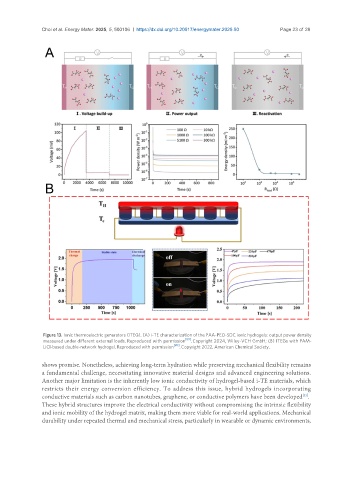
                Figure 13. Ionic thermoelectric generators (ITEG). (A) i-TE characterization of the PAA-PEO-SDC ionic hydrogels: output power density
                                                               [89]
                measured under different external loads. Reproduced with  permission  . Copyright 2024, Wiley-VCH GmbH; (B) ITEGs with PAM-
                                                            [90]
                LiCl-based double-network hydrogel. Reproduced with permission  . Copyright 2022, American Chemical Society.
               shows promise. Nonetheless, achieving long-term hydration while preserving mechanical flexibility remains
               a fundamental challenge, necessitating innovative material designs and advanced engineering solutions.
               Another major limitation is the inherently low ionic conductivity of hydrogel-based i-TE materials, which
               restricts their energy conversion efficiency. To address this issue, hybrid hydrogels incorporating
               conductive materials such as carbon nanotubes, graphene, or conductive polymers have been developed .
                                                                                                       [32]
               These hybrid structures improve the electrical conductivity without compromising the intrinsic flexibility
               and ionic mobility of the hydrogel matrix, making them more viable for real-world applications. Mechanical
               durability under repeated thermal and mechanical stress, particularly in wearable or dynamic environments,

