


Page 86 - Read Online
P. 86
Choi et al. Energy Mater. 2025, 5, 500106  https://dx.doi.org/10.20517/energymater.2025.50  Page 21 of 28


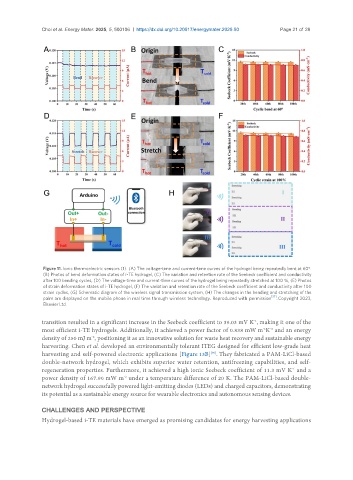
                Figure 11. Ionic thermoelectric sensors (1). (A) The voltage-time and current-time curves of the hydrogel being repeatedly bent at 60°.
                (B) Photos of bend deformation states of i-TE hydrogel, (C) The variation and retention rate of the Seebeck coefficient and conductivity
                after 100 bending cycles, (D) The voltage-time and current-time curves of the hydrogel being repeatedly stretched at 100 %, (E) Photos
                of strain deformation states of i-TE hydrogel, (F) The variation and retention rate of the Seebeck coefficient and conductivity after 100
                strain cycles, (G) Schematic diagram of the wireless signal transmission system, (H) The changes in the bending and stretching of the
                palm are displayed on the mobile phone in real time through wireless technology. Reproduced with  permission [37] . Copyright 2023,
                Elsevier Ltd.

               transition resulted in a significant increase in the Seebeck coefficient to 39.03 mV K , making it one of the
                                                                                       -1
               most efficient i-TE hydrogels. Additionally, it achieved a power factor of 0.838 mW m K  and an energy
                                                                                          -1
                                                                                            -2
                                -2
               density of 250 mJ m , positioning it as an innovative solution for waste heat recovery and sustainable energy
               harvesting. Chen et al. developed an environmentally tolerant ITEG designed for efficient low-grade heat
               harvesting and self-powered electronic applications [Figure 13B] . They fabricated a PAM-LiCl-based
                                                                        [90]
               double-network hydrogel, which exhibits superior water retention, antifreezing capabilities, and self-
               regeneration properties. Furthermore, it achieved a high ionic Seebeck coefficient of 11.3 mV K  and a
                                                                                                   -1
                                           -2
               power density of 167.90 mW m  under a temperature difference of 20 K. The PAM-LiCl-based double-
               network hydrogel successfully powered light-emitting diodes (LEDs) and charged capacitors, demonstrating
               its potential as a sustainable energy source for wearable electronics and autonomous sensing devices.

               CHALLENGES AND PERSPECTIVE
               Hydrogel-based i-TE materials have emerged as promising candidates for energy harvesting applications

