


Page 81 - Read Online
P. 81
Page 16 of 28           Choi et al. Energy Mater. 2025, 5, 500106  https://dx.doi.org/10.20517/energymater.2025.50


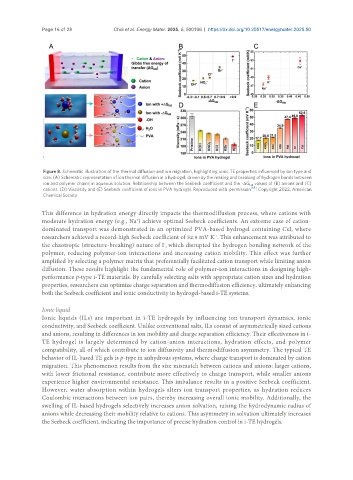
                Figure 8. Schematic illustration of the thermal diffusion and ion migration, highlighting ionic TE properties influenced by ion type and
                size. (A) Schematic representation of ion thermal diffusion in a hydrogel, driven by the making and breaking of hydrogen bonds between
                ion and polymer chains in aqueous solution. Relationship between the Seebeck coefficient and the -ΔG  values of (B) anions and (C)
                                                                                     HB
                                                                                      [68]
                cations. (D) Viscosity and (E) Seebeck coefficient of ions in PVA hydrogel. Reproduced with permission  . Copyright 2022, American
                Chemical Society.
               This difference in hydration energy directly impacts the thermodiffusion process, where cations with
                                               +
               moderate hydration energy (e.g., Na ) achieve optimal Seebeck coefficients. An extreme case of cation-
               dominated transport was demonstrated in an optimized PVA-based hydrogel containing CsI, where
               researchers achieved a record-high Seebeck coefficient of 52.9 mV K . This enhancement was attributed to
                                                                         -1
               the chaotropic (structure-breaking) nature of I , which disrupted the hydrogen bonding network of the
                                                        -
               polymer, reducing polymer-ion interactions and increasing cation mobility. This effect was further
               amplified by selecting a polymer matrix that preferentially facilitated cation transport while limiting anion
               diffusion. These results highlight the fundamental role of polymer-ion interactions in designing high-
               performance p-type i-TE materials. By carefully selecting salts with appropriate cation sizes and hydration
               properties, researchers can optimize charge separation and thermodiffusion efficiency, ultimately enhancing
               both the Seebeck coefficient and ionic conductivity in hydrogel-based i-TE systems.

               Ionic liquid
               Ionic liquids (ILs) are important in i-TE hydrogels by influencing ion transport dynamics, ionic
               conductivity, and Seebeck coefficient. Unlike conventional salts, ILs consist of asymmetrically sized cations
               and anions, resulting in differences in ion mobility and charge separation efficiency. Their effectiveness in i-
               TE hydrogel is largely determined by cation-anion interactions, hydration effects, and polymer
               compatibility, all of which contribute to ion diffusivity and thermodiffusion asymmetry. The typical TE
               behavior of IL-based TE gels is p-type in anhydrous systems, where charge transport is dominated by cation
               migration. This phenomenon results from the size mismatch between cations and anions: larger cations,
               with lower frictional resistance, contribute more effectively to charge transport, while smaller anions
               experience higher environmental resistance. This imbalance results in a positive Seebeck coefficient.
               However, water absorption within hydrogels alters ion transport properties, as hydration reduces
               Coulombic interactions between ion pairs, thereby increasing overall ionic mobility. Additionally, the
               swelling of IL-based hydrogels selectively increases anion solvation, raising the hydrodynamic radius of
               anions while decreasing their mobility relative to cations. This asymmetry in solvation ultimately increases
               the Seebeck coefficient, indicating the importance of precise hydration control in i-TE hydrogels.

