


Page 80 - Read Online
P. 80
Choi et al. Energy Mater. 2025, 5, 500106  https://dx.doi.org/10.20517/energymater.2025.50  Page 15 of 28

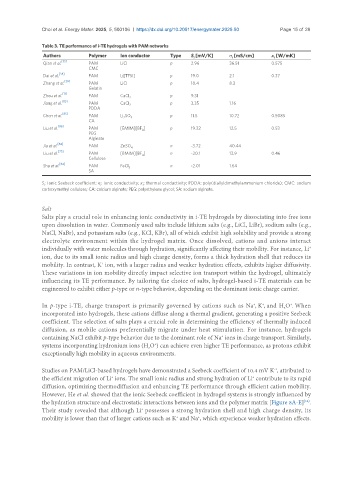
               Table 3. TE performance of i-TE hydrogels with PAM networks
                Authors        Polymer    Ion conductor   Type   S  [mV/K]    σ  [mS/cm]     κ  [W/mK]
                                                                                             i
                                                                  i
                                                                               i
                Qian et al. [35]  PAM     LiCl            p      2.96         36.51          0.575
                               CMC
                     [38]
                Dai et al.     PAM        Li[TFSI]        p      19.0         2.1            0.37
                       [39]
                Zhang et al.   PAM        LiCl            p      10.4         8.3
                               Gelatin
                Zhou et al. [71]  PAM     CaCl 2          p      9.31
                      [83]
                Jiang et al.   PAM        CaCl 2          p      3.35         1.16
                               PDDA
                      [85]
                Chen et al.    PAM        Li SO           p      11.5         10.72          0.5085
                                           2  4
                               CA
                     [86]
                Liu et al.     PAM        [EMIM][BF ]     p      19.32        12.5           0.53
                                                 4
                               PEG
                               Alginate
                    [64]
                Jia et al.     PAM        ZnSO 4          n      -3.72        40.44
                     [75]
                Liu et al.     PAM        [BMIM][BF ]     n      -20.1        13.9           0.46
                                                 4
                               Cellulose
                Sha et al. [84]  PAM      FeCl 3          n      -2.01        1.64
                               SA
               S : Ionic Seebeck coefficient; σ : ionic conductivity; κ : thermal conductivity; PDDA: poly(diallyldimethylammonium chloride); CMC: sodium
                i                  i             i
               carboxymethyl cellulose; CA: calcium alginate; PEG: polyethylene glycol; SA: sodium alginate.
               Salt
               Salts play a crucial role in enhancing ionic conductivity in i-TE hydrogels by dissociating into free ions
               upon dissolution in water. Commonly used salts include lithium salts (e.g., LiCl, LiBr), sodium salts (e.g.,
               NaCl, NaBr), and potassium salts (e.g., KCl, KBr), all of which exhibit high solubility and provide a strong
               electrolyte environment within the hydrogel matrix. Once dissolved, cations and anions interact
               individually with water molecules through hydration, significantly affecting their mobility. For instance, Li
                                                                                                         +
               ion, due to its small ionic radius and high charge density, forms a thick hydration shell that reduces its
               mobility. In contrast, K  ion, with a larger radius and weaker hydration effects, exhibits higher diffusivity.
                                   +
               These variations in ion mobility directly impact selective ion transport within the hydrogel, ultimately
               influencing its TE performance. By tailoring the choice of salts, hydrogel-based i-TE materials can be
               engineered to exhibit either p-type or n-type behavior, depending on the dominant ionic charge carrier.


                                                                                         +
                                                                                                   +
               In p-type i-TE, charge transport is primarily governed by cations such as Na , K , and H O . When
                                                                                      +
                                                                                                 3
               incorporated into hydrogels, these cations diffuse along a thermal gradient, generating a positive Seebeck
               coefficient. The selection of salts plays a crucial role in determining the efficiency of thermally induced
               diffusion, as mobile cations preferentially migrate under heat stimulation. For instance, hydrogels
                                                                            +
               containing NaCl exhibit p-type behavior due to the dominant role of Na  ions in charge transport. Similarly,
               systems incorporating hydronium ions (H O ) can achieve even higher TE performance, as protons exhibit
                                                     +
                                                   3
               exceptionally high mobility in aqueous environments.
               Studies on PAM/LiCl-based hydrogels have demonstrated a Seebeck coefficient of 10.4 mV K , attributed to
                                                                                             -1
               the efficient migration of Li  ions. The small ionic radius and strong hydration of Li  contribute to its rapid
                                                                                      +
                                       +
               diffusion, optimizing thermodiffusion and enhancing TE performance through efficient cation mobility.
               However, He et al. showed that the ionic Seebeck coefficient in hydrogel systems is strongly influenced by
               the hydration structure and electrostatic interactions between ions and the polymer matrix [Figure 8A-E] .
                                                                                                       [68]
               Their study revealed that although Li  possesses a strong hydration shell and high charge density, its
                                                 +
                                                            +
               mobility is lower than that of larger cations such as K  and Na , which experience weaker hydration effects.
                                                                    +

