


Page 78 - Read Online
P. 78
Choi et al. Energy Mater. 2025, 5, 500106  https://dx.doi.org/10.20517/energymater.2025.50  Page 13 of 28


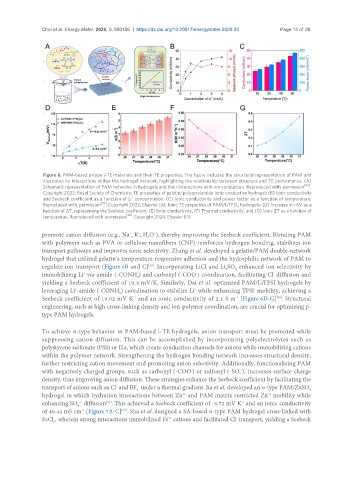
                Figure 6. PAM-based p-type i-TE materials and their TE properties. The figure includes the structural representation of PAM and
                illustrates its interactions within the hydrogel network, highlighting the relationship between structure and TE performance. (A)
                Schematic representation of PAM networks in hydrogels and their interactions with ion conductors. Reproduced with  permission [83] .
                Copyright 2022, Royal Society of Chemistry; TE properties of gelatin/polyacrylamide ionic conductive hydrogel: (B) Ionic conductivity
                                             +
                and Seebeck coefficient as a function of Li  concentration. (C) Ionic conductivity and power factor as a function of temperature.
                                   [39]
                Reproduced with  permission  . Copyright 2022, Elsevier Ltd; Ionic TE properties of PAM/LiTFSI  hydrogels: (D) Increase in -ΔV as a
                                                                                 4
                function of ΔT, representing the Seebeck coefficient. (E) Ionic conductivity, (F) Thermal conductivity, and (G) Ionic ZT as a function of
                temperature. Reproduced with permission [38] . Copyright 2024, Elsevier B.V.
               promote cation diffusion (e.g., Na , K , H O ), thereby improving the Seebeck coefficient. Blending PAM
                                                     +
                                                +
                                             +
                                                   3
               with polymers such as PVA or cellulose nanofibers (CNF) reinforces hydrogen bonding, stabilizes ion
               transport pathways and improves ionic selectivity. Zhang et al. developed a gelatin/PAM double-network
               hydrogel that utilized gelatin’s temperature-responsive adhesion and the hydrophilic network of PAM to
               regulate ion transport [Figure 6B and C] . Incorporating LiCl and Li SO  enhanced ion selectivity by
                                                   [39]
                                                                                4
                                                                             2
               immobilizing Li  via amide (-CONH ) and carboxyl (-COO ) coordination, facilitating Cl  diffusion and
                                                                                             -
                                                                   -
                             +
                                               2
               yielding a Seebeck coefficient of 10.4 mV/K. Similarly, Dai et al. optimized PAM/LiTFSI hydrogels by
                                                                   +
                                                                                       -
                          +
               leveraging Li -amide (-CONH ) coordination to stabilize Li  while enhancing TFSI  mobility, achieving a
                                         2
                                              -1
                                                                                              [38]
                                                                                -1
               Seebeck coefficient of 19.02 mV K  and an ionic conductivity of 2.1 S m  [Figure 6D-G] . Structural
               engineering, such as high cross-linking density and ion-polymer coordination, are crucial for optimizing p-
               type PAM hydrogels.
               To achieve n-type behavior in PAM-based i-TE hydrogels, anion transport must be promoted while
               suppressing cation diffusion. This can be accomplished by incorporating polyelectrolytes such as
               polystyrene sulfonate (PSS) or ILs, which create conduction channels for anions while immobilizing cations
               within the polymer network. Strengthening the hydrogen bonding network increases structural density,
               further restricting cation movement and promoting anion selectivity. Additionally, functionalizing PAM
               with negatively charged groups, such as carboxyl (-COO ) or sulfonyl (-SO ), increases surface charge
                                                                 -
                                                                                  -
                                                                                  3
               density, thus improving anion diffusion. These strategies enhance the Seebeck coefficient by facilitating the
               transport of anions such as Cl  and BF  under a thermal gradient. Jia et al. developed an n-type PAM/ZnSO
                                        -
                                                -
                                               4
                                                                                                         4
                                                               2+
                                                                                           2+
               hydrogel in which hydration interactions between Zn  and PAM matrix restricted Zn  mobility while
               enhancing SO  diffusion . This achieved a Seebeck coefficient of -3.72 mV K  and an ionic conductivity
                                                                                  -1
                            2-
                                     [64]
                           4
               of 40.44 mS cm  [Figure 7A-C] . Sha et al. designed a SA-based n-type PAM hydrogel cross-linked with
                             -1
                                          [64]
               FeCl , wherein strong interactions immobilized Fe  cations and facilitated Cl  transport, yielding a Seebeck
                                                                                 -
                                                          3+
                   3

